Many investors searching for stable investment options eventually consider bonds. However, one question often creates confusion: what do ratings such as AAA, AA or A actually mean?
It is easy to assume that every bond carries the same level of safety because it promises regular interest payments. In reality, every bond carries a different level of credit risk. That is where bond ratings in India become important.
Bond ratings help investors understand a company’s ability to repay interest and principal on time. While a higher rating generally indicates stronger credit quality, it does not eliminate investment risk entirely.
This guide explains how bond ratings work, what each rating signifies and how investors can use them while evaluating fixed-income investments.
On this page
Key Takeaways: Bond Ratings in India
Understanding bond ratings helps investors evaluate credit risk more effectively.
- Bond ratings measure the issuer’s creditworthiness.
- AAA generally represents the highest credit quality.
- Lower ratings indicate relatively higher credit risk.
- Ratings may change over time based on financial performance.
- Bond ratings should be considered alongside your financial goals.
What Are Bond Ratings?
Bond ratings are independent assessments of an issuer’s ability to repay its debt obligations according to the agreed terms.
Credit rating agencies evaluate several aspects before assigning a rating, including:
- Financial strength
- Debt levels
- Cash flow
- Business stability
- Industry outlook
- Management quality
These ratings help investors compare bonds issued by different companies without having to analyse every financial statement themselves.
In India, recognised credit rating agencies include:
- CRISIL
- ICRA
- CARE Ratings
- India Ratings and Research (Fitch Group)
- Acuité Ratings
- Brickwork Ratings
- Infomerics Ratings
All credit rating agencies operating in India are registered with and regulated by SEBI under the Credit Rating Agencies Regulations, 1999. (Source: SEBI | SEBI (Credit Rating Agencies) Regulations, 1999 )
Each agency follows its own analytical framework, although rating scales are broadly comparable.
Understanding Bond Ratings in India
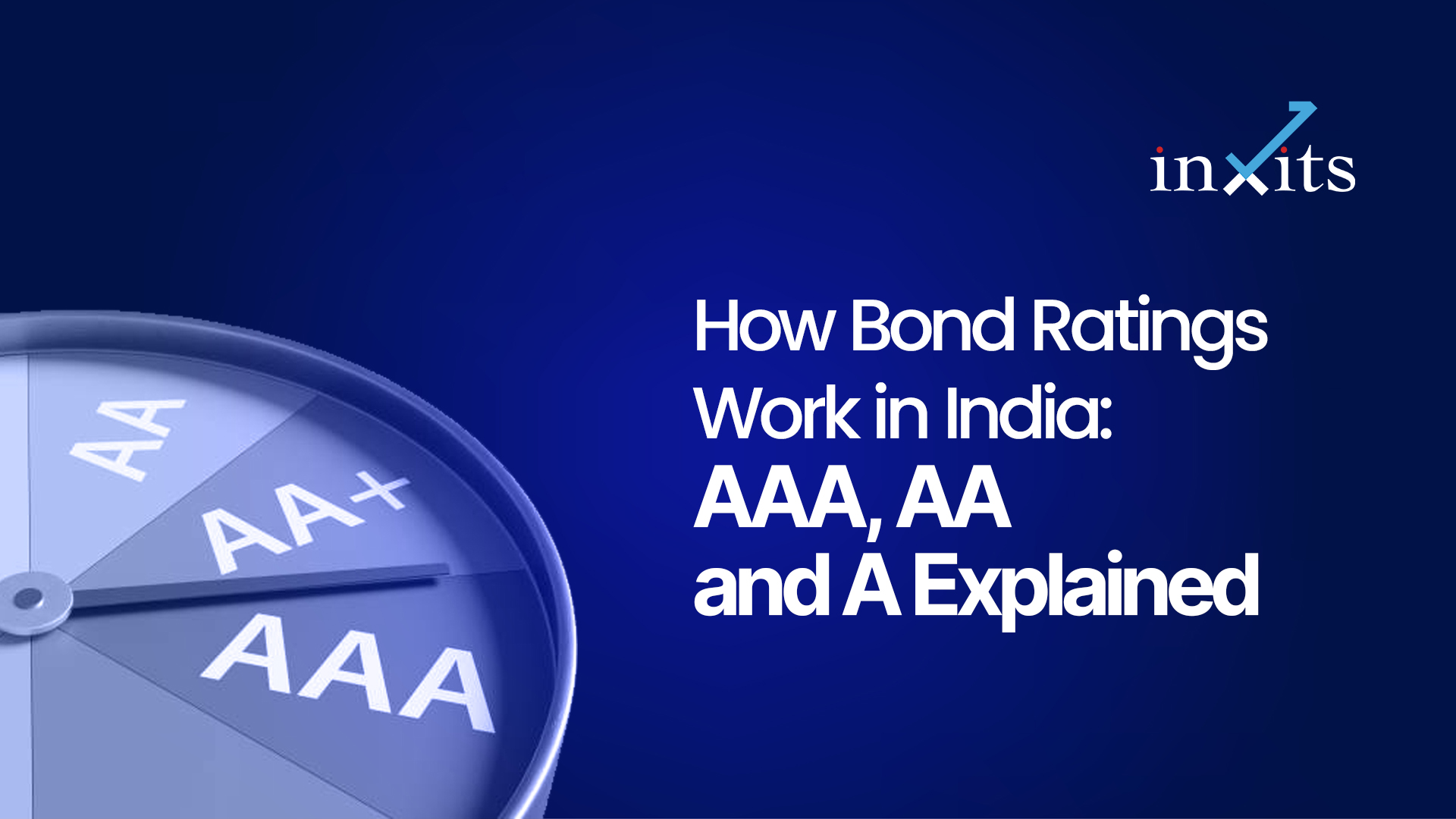
The rating scale generally follows a hierarchy from the strongest credit quality to higher-risk categories.
| Rating | General Meaning |
| AAA | Highest credit quality with very strong repayment capacity |
| AA | High credit quality with very low credit risk |
| A | Adequate capacity to meet obligations but relatively higher risk than AA |
| BBB | Moderate credit quality with greater sensitivity to economic conditions |
| BB and Below D | Higher credit risk and increased possibility of repayment difficulties Default, issuer has failed to meet repayment obligations |
Ratings from AAA to BBB are generally considered investment-grade. Ratings from BB downwards are sometimes called high-yield or speculative-grade. “D” indicates the issuer has already defaulted.
These ratings reflect the issuer’s creditworthiness rather than expected investment returns.
What Does AAA Rating Mean?
AAA represents the highest rating assigned to corporate debt instruments.
Companies with AAA ratings are generally considered to have a very strong capacity to meet their financial commitments even during changing economic conditions.
However, investors should remember that AAA does not mean risk-free. Market risks, interest rate movements and liquidity risks may still affect bond prices.
For investors seeking relatively higher credit quality, many safe bonds India options often include highly rated issuers.
What Is the Difference Between AA and A Rated Bonds?
AA-rated bonds also indicate strong repayment capacity.
However, compared with AAA issuers, they may be slightly more sensitive to changes in business conditions or economic environments.
A-rated bonds remain investment-grade instruments but generally carry relatively higher credit risk than AA-rated bonds.
In simple terms:
- AAA indicates stronger financial resilience.
- AA indicates high credit quality with slightly higher risk.
- A indicates adequate repayment capacity but greater sensitivity to business conditions.
Understanding these differences helps investors balance risk and return expectations.
What Happens Below Investment Grade?
Ratings below BBB generally indicate increasing credit risk.
These issuers may experience greater financial pressure during economic slowdowns or business challenges.
Lower-rated bonds may offer higher interest rates because investors demand additional compensation for taking greater credit risk.
However, higher returns should never be viewed in isolation.
Investors should evaluate whether the additional yield appropriately compensates for the higher probability of credit-related risks.
How Are Corporate Bond Ratings in India Assigned?
Credit rating agencies analyse multiple qualitative and quantitative factors before assigning a rating.
Some of the important considerations include:
Financial Performance
Agencies review profitability, revenue trends, operating margins and cash flow generation.
Debt Levels
Companies with manageable debt relative to earnings generally receive stronger credit assessments.
Industry Position
Businesses operating in stable industries with predictable demand may receive favourable evaluations.
Liquidity
The ability to meet short-term financial obligations also influences credit ratings.
Corporate Governance
Management quality, governance standards and transparency are important qualitative considerations.
Because business conditions evolve, corporate bond ratings India may also be upgraded or downgraded over time.
Invest Smarter.
Grow Confidently.
Your AI-powered SEBI-registered investment advisor — with research you can trust and insights that grow with you.
Download inXits Free
Do Bond Ratings Ever Change?
Yes.
Credit ratings are not permanent.
Rating agencies continuously monitor issuers and may revise ratings when significant changes occur.
Ratings may improve because of:
- Lower debt
- Stronger profitability
- Better cash flows
- Improved business outlook
Similarly, ratings may decline due to:
- Weak financial performance
- Rising debt
- Liquidity concerns
- Industry challenges
- Corporate governance issues
Therefore, investors should periodically review the ratings of bonds they already hold.
Are Higher-Rated Bonds Always Better?
Not necessarily.
Higher-rated bonds generally carry lower credit risk, but they may also offer relatively lower yields.
Lower-rated bonds may provide higher coupon rates because investors accept greater credit risk.
The appropriate choice depends on several factors:
- Investment objective
- Risk tolerance
- Income requirements
- Investment horizon
- Overall portfolio allocation
Rather than focusing only on ratings, investors should evaluate how each bond fits within their broader financial plan.
If you are considering fixed-income investments, understanding how to buy bonds online can simplify access to various bond categories available in the market.
Common Mistakes Investors Make
Many investors misunderstand the purpose of bond ratings.
Some common mistakes include:
- Assuming AAA means completely risk-free.
- Choosing only the highest interest rate.
- Ignoring changes in credit ratings after investing.
- Investing without understanding the issuer’s business.
- Concentrating investments in a single bond issuer.
Avoiding these mistakes can help create a more balanced fixed-income portfolio.
Unsure how different bond ratings fit your investment goals? A fixed income advisor can help you understand credit quality, diversification and how bonds complement your overall financial plan.
How inXits Helps Investors Evaluate Bonds
Choosing bonds involves more than comparing coupon rates or maturity dates. Credit quality, issuer strength, portfolio diversification and investment objectives all influence whether a bond is appropriate for a particular investor.
At inXits, advisors help investors understand fixed-income investments by evaluating bond credit quality alongside broader financial goals. Rather than focusing only on yields, the emphasis remains on balancing risk, liquidity and long-term portfolio stability.
If you are looking to build a diversified fixed-income portfolio, working with a bond investment advisor can help you evaluate available opportunities more systematically.
Conclusion
Understanding bond ratings in India helps investors make more informed decisions before investing in fixed-income securities. Ratings such as AAA, AA and A provide valuable insight into an issuer’s creditworthiness, although they should never be the only factor considered.
A well-informed investment decision combines credit ratings with an understanding of financial goals, diversification and risk tolerance. Regularly reviewing bond ratings also helps investors remain aware of changes in issuer credit quality over time.
Whether you are investing for regular income or portfolio diversification, evaluating bond credit ratings carefully can support more structured financial decision-making. If you need personalised guidance before selecting fixed-income investments, consulting a financial advisor can help you choose investments aligned with your long-term objectives.
Frequently Asked Questions
What are bond ratings in India?
Bond ratings are independent assessments of an issuer’s ability to repay interest and principal according to the terms of the bond.
Which agencies assign bond ratings in India?
Major credit rating agencies include CRISIL, ICRA, CARE Ratings, India Ratings and Research, and Acuité Ratings.
What does a AAA bond rating mean?
AAA generally indicates the highest level of credit quality and a very strong capacity to meet debt obligations, although it does not eliminate investment risk.
Are AA-rated bonds safe?
AA-rated bonds are generally considered to have high credit quality. However, like all investments, they still carry certain risks depending on market conditions and the issuer’s financial health.
What does a “D” bond rating mean?
A “D” rating indicates that the issuer has already defaulted, meaning it has failed to make scheduled interest or principal payments. This is the lowest rating on the scale and is the outcome that bond ratings are designed to help investors avoid.
Can bond ratings change after investment?
Yes. Credit rating agencies regularly review issuers and may upgrade or downgrade ratings based on changes in financial performance, debt levels and business conditions.
Do lower-rated bonds always provide better returns?
Lower-rated bonds often offer higher interest rates because they involve greater credit risk. Investors should evaluate both risk and return before investing.
Should I rely only on bond ratings while investing?
No. Bond ratings are one important factor, but investors should also consider financial goals, diversification, investment horizon and overall portfolio strategy.
How can a bond investment advisor help?
A bond investment advisor helps investors understand bond credit ratings, compare available options and select fixed-income investments that align with their financial objectives.
Disclaimer
Investments in securities markets are subject to market risks. Read all related documents carefully before investing.
inXits is a SEBI-registered investment adviser (Registration No. INA000020369). This article is for educational purposes only and does not constitute personalised investment advice.
Registration granted by SEBI, membership of BSE, and certification from NISM in no way guarantee performance of the intermediary or provide any assurance of returns to investors.

Himani Barot, CFP, is a Principal Officer at inXits with 4+ years of experience in portfolio management, investment advisory, and comprehensive financial planning. As a Certified Financial Planner, she helps clients navigate complex financial goals with structured, personalised strategies.