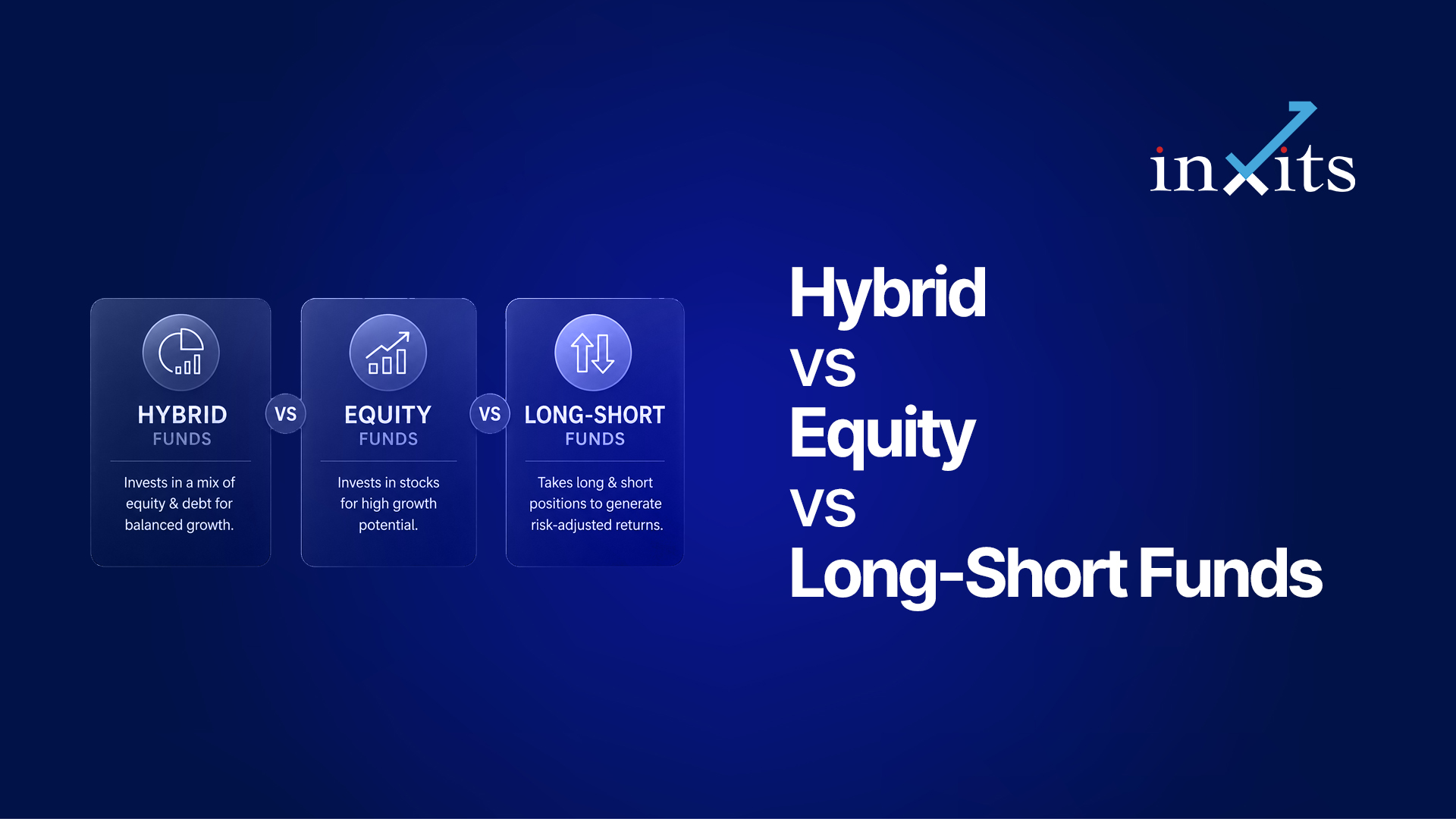
Choosing a mutual fund is rarely as simple as picking the category with the highest recent return. Many investors compare Hybrid vs Equity vs Long-Short Funds because each category appears to offer a different balance between growth and risk.
The confusion is understandable. Equity funds focus on long-term wealth creation through stocks. Hybrid funds combine equity and debt exposure to reduce portfolio fluctuations. Long-short funds use a more specialised strategy that attempts to benefit from both rising and falling market opportunities.
For investors trying to build a portfolio aligned with their goals, the better question is not which category is superior. The more useful question is which category matches a particular financial objective, risk tolerance, and investment horizon.
This article explains how these three fund categories work, where they differ, and how investors can evaluate them within a broader financial plan.
On this page
Hybrid vs Equity vs Long-Short Funds in India: Key Takeaways
Before comparing the categories, keep these points in mind:
- Equity funds focus primarily on stock market growth.
- Hybrid funds combine equity and fixed-income exposure.
- Long-short funds use both buying and selling strategies.
- Risk levels vary significantly across the three categories.
- Suitability depends more on goals than category popularity.
What Are Equity, Hybrid, and Long-Short Funds?
All three categories invest differently and serve different purposes within a portfolio.
What Are Equity Funds?
Equity funds invest predominantly in listed company shares. Their objective is long-term capital appreciation through participation in business growth.
These funds may focus on large-cap, mid-cap, small-cap, sectoral, thematic, or diversified strategies. Since equity exposure remains high, investors should expect short-term volatility.
For investors building long-term wealth, a diversified equity allocation often forms the foundation of a portfolio. Many investors work with a mutual fund advisor to determine which equity categories align with their risk profile.
What Are Hybrid Funds?
Hybrid funds combine equity and debt investments within a single scheme.
The equity component aims to generate growth, while the debt allocation seeks to reduce overall portfolio volatility. Depending on the category, the equity allocation can range from conservative to aggressive.
For example, aggressive hybrid funds generally maintain higher equity exposure, while conservative hybrid funds allocate more towards debt instruments.
What Are Long-Short Funds?
Long-short funds use a strategy that takes both long and short positions.
A long position benefits when an asset rises in value. A short position benefits when the asset declines. By combining both approaches, fund managers attempt to manage market exposure while seeking opportunities across different market conditions.
These strategies are more common in Alternative Investment Funds (AIFs) and specialised portfolio structures than in traditional mutual funds. Investors interested in such strategies often evaluate them alongside portfolio management service solutions.
How Do Risk Levels Differ Across These Categories?
Risk is one of the biggest differences between these fund types.
The following comparison provides a broad framework:
| Factor | Equity Funds | Hybrid Funds | Long-Short Funds |
| Equity Exposure | High (minimum 65% as per SEBI norms) | Moderate to High (10–80%, depending on sub-category) | Variable, strategy dependent |
| Volatility | High | Moderate | Moderate, but with different sources of risk |
| Debt Allocation | Minimal | Meaningful (20–90%, depending on sub-category) | Usually limited |
| Market Dependence | High | Medium | Lower than pure equity |
| Complexity | Low to Moderate | Moderate | High |
| Minimum Investment | No minimum (on most investment platforms) | No minimum (on most investment platforms) | ₹1 crore (AIF) / ₹50 lakh (PMS) |
| Suitable Investment Horizon | 5+ years | 3–5+ years | Strategy dependent; consult a financial adviser |
| Regulatory Framework | SEBI (Mutual Funds) Regulations, 1996 | SEBI (Mutual Funds) Regulations, 1996 | SEBI AIF Regulations, 2012 / SEBI PMS Regulations, 2020 |
Source links:
SEBI Circular on Categorisation and Rationalisation of Mutual Fund Schemes, 2017
Many first-time investors assume lower volatility automatically means lower risk. However, risk should always be viewed in relation to financial goals.
Which Category Feels Less Volatile?
Hybrid funds generally experience lower volatility because debt investments help cushion market declines.
For example, during periods of market uncertainty, a portfolio with both debt and equity components may fluctuate less than a portfolio invested entirely in equities.
Are Long-Short Funds Safer Than Equity Funds?
Not necessarily.
Long-short strategies attempt to reduce directional market exposure. However, they introduce strategy risk, manager risk, and execution risk.
A lower correlation with broad market movements does not automatically make a strategy less risky. It simply means the sources of risk are different.
Which Fund Category Fits Different Investor Profiles?
There is no universal winner in the Hybrid vs Equity vs Long-Short Funds debate. Suitability depends on investor circumstances.
Investors Focused on Long-Term Wealth Creation
Investors with investment horizons exceeding five years often consider diversified equity funds because they participate directly in economic and corporate growth.
A salaried professional in Bengaluru investing for retirement 20 years away may prioritise long-term growth over short-term stability.
Investors Seeking a Balanced Approach
Hybrid funds often appeal to investors who want exposure to equities but prefer smoother portfolio behaviour.
Many investors approaching major goals such as a home purchase or children’s education use hybrid allocations to balance growth and stability.
Investors Seeking Alternative Strategies
Long-short funds generally attract experienced investors who understand strategy-based investing and can evaluate performance beyond traditional market benchmarks.
These strategies often appear alongside broader allocations managed through a PMS advisor or alternative investment framework.
Assumption vs Reality
What most investors assume
Higher risk automatically produces better outcomes.
What actually happens
Invest Smarter.
Grow Confidently.
Your AI-powered SEBI-registered investment advisor — with research you can trust and insights that grow with you.
Download inXits Free
Returns and risk do not move in a straight line. An unsuitable high-risk strategy can create emotional decisions that hurt long-term results.
Why this matters
The most effective investment strategy is often the one an investor can remain committed to through changing market conditions.
What Factors Should Drive Your Decision?
Selecting between Hybrid vs Equity vs Long-Short Funds requires a structured evaluation.
Consider the following factors:
- Investment objective.
- Time horizon.
- Income stability.
- Existing portfolio allocation.
- Liquidity requirements.
- Comfort with market fluctuations.
- Understanding of advanced investment strategies.
Many investors focus heavily on return comparisons. However, fund selection should begin with goals rather than historical performance.
How Important Is Time Horizon?
Time horizon influences risk capacity significantly.
An investor saving for retirement over 25 years may tolerate greater equity exposure. Conversely, someone planning to use the money within three years may prioritise capital preservation.
Should You Choose Only One Category?
Not always.
Many diversified portfolios include multiple fund categories because different assets play different roles.
For example, equities may drive growth, hybrid funds may support stability, and specialised strategies may provide diversification.
If you are unsure whether your current fund mix aligns with your goals, a review with a SEBI registered mutual fund advisor can help identify overlaps, concentration risks, and allocation gaps.
How Can Investors Build a More Balanced Portfolio?
A strong portfolio rarely depends on a single category.
Instead, successful portfolio construction focuses on combining assets that serve different functions. Equity funds can support growth. Hybrid funds can moderate volatility. Alternative strategies may add diversification when used appropriately.
Many investors begin by defining goals and then selecting suitable fund categories. This process is often more effective than starting with a fund category and hoping it matches future requirements.
Before making allocation decisions, it also helps to understand how your investments interact across accounts. Tools such as a portfolio tracker can provide a clearer view of overall asset allocation.
Investors who want to compare growth projections across different contribution levels can also use a SIP calculator to estimate how regular investments may support long-term objectives.
How inXits Helps Investors Evaluate Fund Categories
Comparing Hybrid vs Equity vs Long-Short Funds requires more than reviewing recent returns. The more important consideration is how each category fits within a broader financial plan.
At inXits, advisors evaluate factors such as investment goals, risk tolerance, time horizon, portfolio concentration, and asset allocation before recommending any investment framework. The focus remains on aligning investments with financial objectives rather than short-term market trends.
Many investors struggle with questions such as how much equity exposure they need, whether a hybrid allocation is appropriate, or when alternative strategies may be relevant. Those decisions often become clearer when viewed within the context of a complete financial plan.
If you want guidance on structuring your portfolio around specific financial goals, connecting with a sebi registered mutual fund advisor can help you evaluate suitable allocation frameworks and identify potential gaps in your current strategy.
Conclusion
The debate around Hybrid vs Equity vs Long-Short Funds does not have a universal answer. Each category serves a different purpose within an investment portfolio.
Equity funds focus on long-term growth through stock market participation. Hybrid funds attempt to balance growth and stability by combining asset classes. Long-short funds use more advanced strategies designed to operate across varying market conditions.
Rather than searching for the category with the strongest recent performance, investors benefit from understanding which category supports their goals, risk tolerance, and investment horizon. A thoughtful allocation framework often matters more than selecting a single category.
If you are uncertain whether your portfolio reflects your financial objectives, discussing your allocation with a financial advisor can help bring greater clarity to long-term investment decisions.
Frequently Asked Questions
What is the difference between Hybrid vs Equity vs Long-Short Funds?
Equity funds primarily invest in stocks, hybrid funds combine equity and debt exposure, and long-short funds use both long and short positions. Each category has different risk characteristics, return drivers, and portfolio applications.
Which is better: Hybrid vs Equity vs Long-Short Funds?
No category is universally better. The suitable choice depends on investment goals, risk tolerance, financial circumstances, and investment horizon.
Are hybrid funds less risky than equity funds?
Hybrid funds generally experience lower volatility because they include debt exposure. However, risk should always be evaluated relative to the investor’s goals and time horizon.
Do long-short funds always perform well in falling markets?
Not necessarily. Long-short strategies depend on manager decisions, market conditions, and execution quality. They are not designed to guarantee positive outcomes during market declines.
Can beginners invest in long-short funds?
Many beginners find traditional equity or hybrid funds easier to understand. Long-short strategies involve additional complexity and require a deeper understanding of investment mechanics.
How does SEBI regulate these fund categories?
The Securities and Exchange Board of India (SEBI) regulates mutual funds, investment advisers, and various investment products. Regulatory frameworks differ depending on the structure and category involved.
Can I hold both hybrid and equity funds?
Yes. Many diversified portfolios include both categories because they serve different purposes. Equity funds may support growth, while hybrid funds may help manage volatility.
How should salaried investors choose between these categories?
Salaried investors should evaluate their goals, income stability, emergency fund status, and investment horizon before selecting fund categories.
Disclaimer
Investments in securities markets are subject to market risks. Read all related documents carefully before investing.
inXits is a SEBI-registered investment adviser (Registration No. INA000020369). This article is for educational purposes only and does not constitute personalised investment advice.
Registration granted by SEBI, membership of BSE, and certification from NISM in no way guarantee performance of the intermediary or provide any assurance of returns to investors.

Aditya Rajpurohit is a Mutual Fund Research Analyst at inXits with 5+ years of experience in equity and mutual fund analysis. He specialises in fund selection, portfolio construction, and long-term wealth creation strategies for retail and HNI investors.