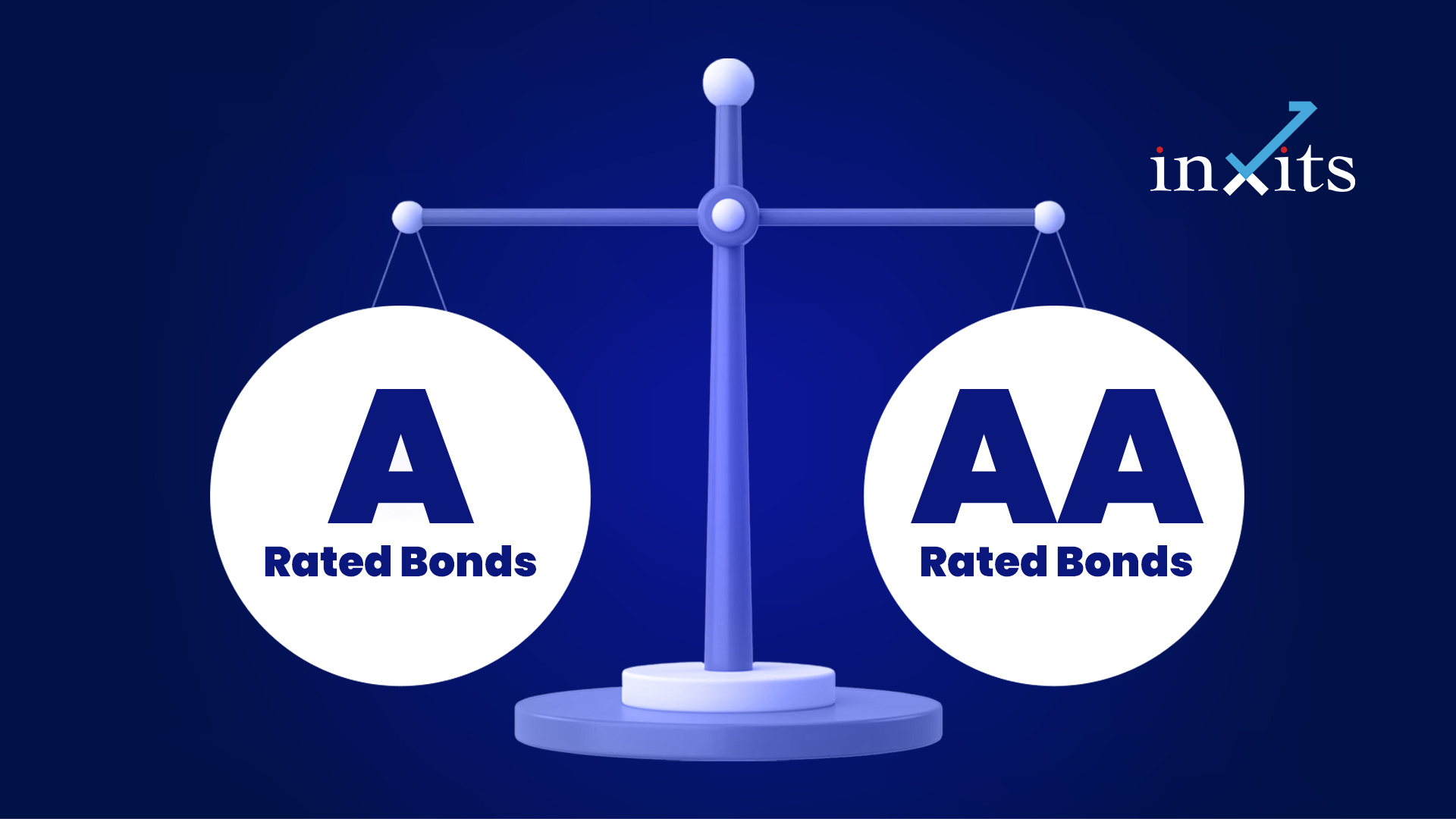
When comparing corporate bonds, one question often comes up: Should you choose a higher-rated bond with a lower yield or accept more risk for potentially higher returns? This is where the debate around AA vs A rated bonds becomes relevant.
Many investors notice that A-rated bonds generally offer a higher coupon or yield than AA-rated bonds. At first glance, earning an extra percentage point or two may seem attractive. However, higher yields usually reflect higher credit risk rather than a free opportunity to earn more.
Understanding what bond ratings actually represent can help investors make more informed fixed-income decisions. This guide explains the differences between AA and A rated bonds in India, how credit ratings influence yields, and the factors investors should consider before making a choice.
On this page
Key Takeaways: AA vs A Rated Bonds
Choosing a bond is about balancing return with risk.
- Higher bond yields generally come with higher credit risk.
- AA-rated bonds typically have stronger credit profiles than A-rated bonds.
- Bond ratings are opinions about creditworthiness, not guarantees.
- Investment decisions should match your financial goals and risk tolerance.
- Diversification remains important even within fixed-income investments.
What Do Bond Ratings Mean?
Bond ratings represent an independent assessment of an issuer’s ability to repay interest and principal on time.
In India, recognised credit rating agencies evaluate corporate issuers based on factors such as:
- Financial strength
- Debt repayment capacity
- Cash flow stability
- Business performance
- Industry outlook
- Management quality
Higher ratings generally indicate stronger credit quality, while lower ratings suggest relatively greater credit risk.
It is important to remember that ratings are opinions based on available information and may change over time if a company’s financial position changes.
Understanding AA Rated Bonds India
AA rated bonds India are generally considered to have a high degree of safety regarding timely servicing of financial obligations.
Although they carry slightly more credit risk than AAA-rated bonds, they are still viewed as relatively strong credit instruments.
Common characteristics include:
- Strong financial position
- Better debt servicing capability
- Lower probability of default compared with lower-rated bonds
- Relatively lower yields compared with A-rated bonds
Because investors perceive lower risk, issuers with AA ratings often borrow at lower interest rates.
Understanding A Rated Bonds India
A rated bonds India also fall within the investment-grade category.
However, they generally carry higher credit risk than AA-rated bonds.
These issuers may remain financially stable, but they could be more sensitive to economic slowdowns, industry challenges or business-specific developments.
As compensation for accepting this additional credit risk, investors often receive relatively higher yields.
Higher yield does not necessarily mean a better investment. Instead, it reflects the market’s assessment of higher uncertainty.
AA vs A Rated Bonds: Key Differences
| Feature | AA Rated Bonds | A Rated Bonds |
| Credit Quality | Higher | Moderate |
| Default Risk | Lower | Relatively Higher |
| Typical Yield | Lower | Higher |
| Risk During Economic Stress | Lower | Higher |
| Suitable For | Conservative fixed-income investors | Investors willing to accept relatively higher credit risk |
The primary difference lies in the issuer’s perceived ability to meet future debt obligations under changing business conditions.
Why Do A Rated Bonds Offer Higher Yields?
Many investors assume that higher yields always indicate better investment opportunities.
In reality, the opposite is often true.
Bond markets generally require additional compensation when investors accept greater uncertainty.
For example, if two companies borrow for similar periods but one has a stronger financial profile, investors may accept a lower yield because they perceive lower credit risk.
The company with relatively weaker credit quality usually needs to offer higher yields to attract investors.
This relationship between risk and return forms the foundation of most bond yield comparison decisions.
Should You Always Choose Higher-Rated Bonds?
Not necessarily.
The appropriate choice depends on several factors.
Consider the following questions:
- What is your investment objective?
- How important is capital preservation?
- Can your portfolio tolerate higher credit risk?
- Are you investing for regular income or long-term wealth preservation?
Conservative investors often prioritise credit quality over higher yields.
Others may allocate a limited portion of their portfolio to lower-rated bonds after understanding the associated risks.
Rather than selecting bonds purely based on ratings, investors should evaluate the overall quality of the issuer and how the investment fits within their broader asset allocation.
If you are building a diversified fixed-income portfolio, working with a fixed income advisor can help align bond selection with your financial objectives.
Corporate Bond Risk Levels: What Else Should Investors Evaluate?
Credit rating is important, but it should not be the only factor influencing your decision.
Investors should also review:
Business Fundamentals
Companies with stable revenue and consistent cash flows generally demonstrate stronger debt repayment capacity.
Debt Levels
Higher leverage may increase financial pressure during challenging business conditions.
Industry Outlook
Some industries experience greater earnings volatility than others, which may influence future credit quality.
Invest Smarter.
Grow Confidently.
Your AI-powered SEBI-registered investment advisor — with research you can trust and insights that grow with you.
Download inXits Free
Liquidity
Liquidity affects how easily investors can buy or sell bonds in the secondary market.
Rating Outlook
Credit ratings may be upgraded, downgraded or reaffirmed depending on changes in business performance.
Looking beyond the rating itself often provides a more balanced assessment of credit quality.
Common Misconceptions About Bond Ratings
Several misconceptions influence investment decisions.
Myth: AA-rated bonds are risk-free.
Reality: Every corporate bond carries some level of credit risk. Higher ratings generally indicate lower relative risk rather than complete safety.
Myth: Higher yield always means better returns.
Reality: Higher yields often compensate investors for accepting greater credit risk.
Myth: Bond ratings never change.
Reality: Credit rating agencies periodically review issuers and may revise ratings based on evolving financial conditions.
Understanding these differences helps investors evaluate bonds more objectively.
If you are unsure how different bond ratings fit into your investment strategy, consulting a bond investment advisor can help you assess fixed-income opportunities according to your financial goals and risk tolerance.
How Bond Ratings Fit Into Portfolio Allocation
Most experienced investors avoid concentrating all fixed-income investments within a single issuer or rating category.
Diversification across issuers, maturities and credit ratings can help reduce portfolio concentration risk.
For example, an investor may combine government securities, highly rated corporate bonds and other fixed-income instruments depending on their investment objectives.
The appropriate allocation differs from one investor to another.
Therefore, bond ratings should be viewed as one part of the overall investment decision rather than the only deciding factor.
How inXits Helps Investors Evaluate Fixed-Income Investments
Selecting corporate bonds involves much more than comparing coupon rates or yields. Investors also need to understand credit quality, issuer strength, liquidity, maturity and how each investment fits within their overall financial plan.
At inXits, advisors help investors evaluate fixed-income opportunities by considering both return expectations and potential risks. Instead of focusing only on higher yields, the discussion centres on building a diversified portfolio aligned with long-term financial goals.
If you are considering corporate bonds, working with a fixed income advisor can help you understand different bond categories and build a structured investment strategy.
Conclusion
The debate around AA vs A rated bonds is ultimately about balancing yield with credit risk. While A-rated bonds often provide higher yields, those additional returns generally compensate investors for accepting relatively greater uncertainty.
AA-rated bonds usually offer stronger credit quality but may deliver comparatively lower yields. Neither category is universally better. The appropriate choice depends on your financial goals, investment horizon and willingness to accept credit risk.
Understanding bond ratings alongside business fundamentals, issuer strength and portfolio diversification helps investors make more informed fixed-income decisions.
If you would like professional guidance before investing in corporate bonds, speaking with a financial advisor can help you build a fixed-income portfolio suited to your long-term financial objectives.
Frequently Asked Questions
What is the difference between AA and A rated bonds?
AA-rated bonds generally have stronger credit quality and lower perceived default risk than A-rated bonds. A-rated bonds typically offer higher yields to compensate investors for accepting relatively greater credit risk.
Are AA rated bonds safe?
AA-rated bonds are generally considered to have a high degree of safety regarding timely repayment of financial obligations. However, they are not risk-free, and all corporate bonds carry some level of credit risk.
Why do A rated bonds offer higher yields?
A-rated bonds generally provide higher yields because investors require additional compensation for accepting greater credit risk compared with higher-rated issuers.
Can bond ratings change over time?
Yes. Credit rating agencies periodically review issuers and may upgrade, downgrade or reaffirm ratings depending on changes in financial performance and business conditions.
Should I invest only in AA rated bonds?
Not necessarily. The appropriate allocation depends on your investment objectives, risk tolerance and overall portfolio strategy rather than credit rating alone.
What factors should I evaluate besides bond ratings?
Investors should also review issuer financial strength, debt levels, cash flows, industry outlook, liquidity, maturity and diversification before investing.
What does bond yield comparison indicate?
Bond yield comparison helps investors understand how much additional return is offered relative to the credit risk and other characteristics of different bond issuers.
How can a fixed income advisor help?
A fixed income advisor helps evaluate corporate bond quality, understand credit ratings, compare investment options and build a diversified portfolio aligned with long-term financial goals.
Disclaimer
Investments in securities markets are subject to market risks. Read all related documents carefully before investing.
inXits is a SEBI-registered investment adviser (Registration No. INA000020369). This article is for educational purposes only and does not constitute personalised investment advice.
Registration granted by SEBI, membership of BSE, and certification from NISM in no way guarantee performance of the intermediary or provide any assurance of returns to investors.

Himani Barot, CFP, is a Principal Officer at inXits with 4+ years of experience in portfolio management, investment advisory, and comprehensive financial planning. As a Certified Financial Planner, she helps clients navigate complex financial goals with structured, personalised strategies.