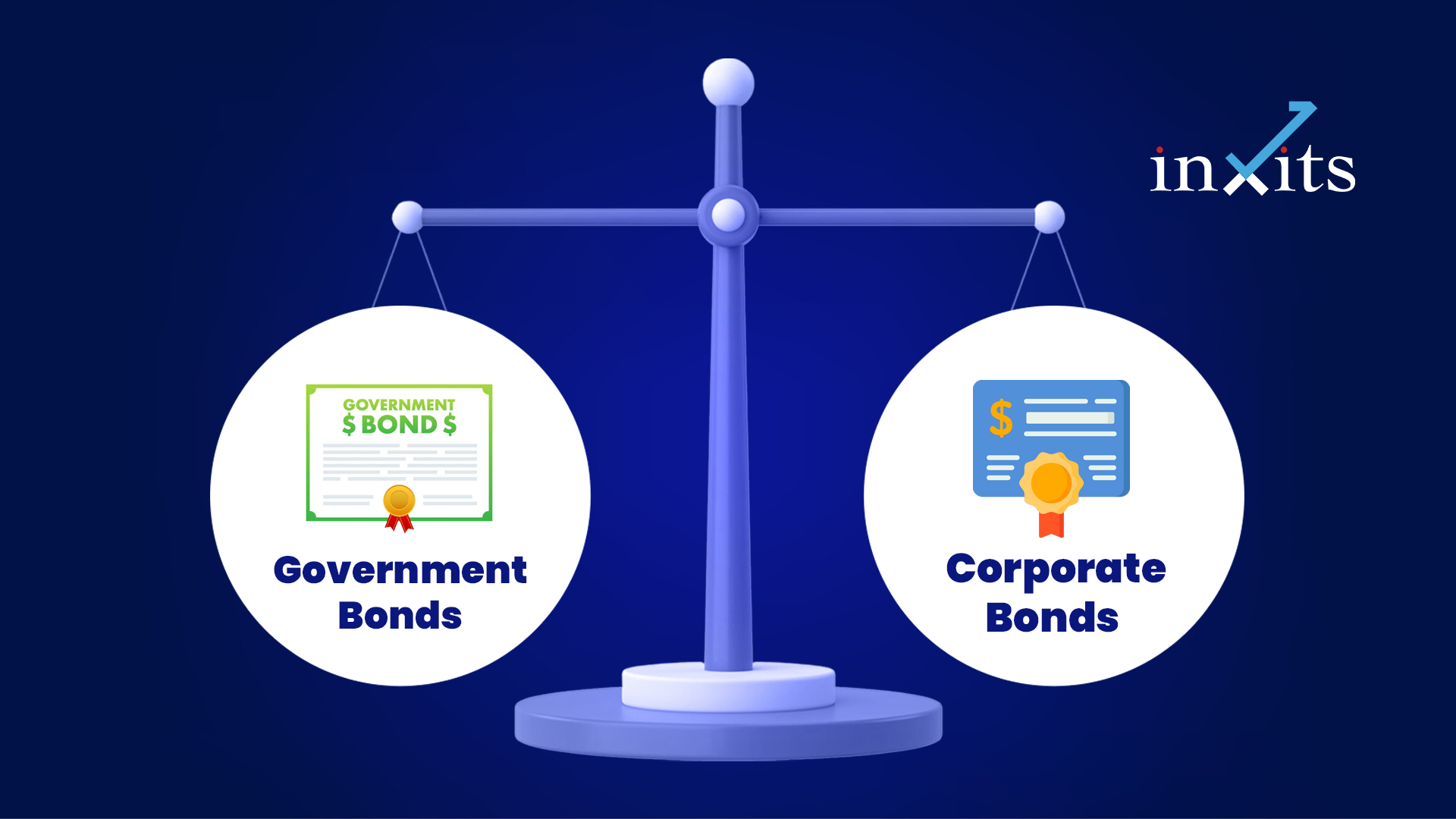
When investors begin exploring fixed income investments, one of the first questions they encounter is whether government bonds are safer than corporate bonds. Another common question quickly follows: if corporate bonds carry credit ratings, do sovereign bonds require the same kind of evaluation?
The answer is more nuanced than it may appear. While both government and corporate bonds are debt instruments, the risks associated with them are not identical. Understanding who issues the bond, how repayment is supported and what credit ratings actually measure can help investors make more informed decisions.
This guide explains the differences between government bonds vs corporate bonds, the role of sovereign bonds in India, and why credit ratings carry different significance depending on the issuer.
On this page
Key Takeaways: Government Bonds vs Corporate Bonds
Before comparing the two bond categories, here are the key points.
- Government bonds and corporate bonds carry different types of risk.
- Sovereign bonds are issued by the Government of India and managed through RBI, retail investors can access them directly via RBI Retail Direct.
- Corporate bond ratings help assess the issuer’s creditworthiness.
- Higher yields often reflect higher risk.
- Bond selection should align with your financial goals and risk appetite.
What Are Government Bonds?
In India, Government Securities (G-Secs) and Treasury Bills are issued by the Government of India and managed by the Reserve Bank of India (RBI).
Retail investors can purchase these directly through the RBI Retail Direct platform, a SEBI and RBI initiative that allows individual investors to buy government securities without going through a broker. (Source: RBI Retail Direct – rbiretaildirect.org.in)
Government bonds are debt securities issued by the Government of India to raise funds for public expenditure and infrastructure development.
When investors purchase these securities, they lend money to the government in exchange for periodic interest payments and repayment of principal upon maturity.
Examples include:
- Government Securities (G-Secs)
- Treasury Bills (T-Bills)
- State Development Loans (SDLs)
Because these securities are backed by the sovereign government, they generally carry relatively lower credit risk compared to most corporate debt instruments.
Investors seeking relatively stable fixed income investments often include government securities as part of their long-term portfolio.
What Are Corporate Bonds?
Corporate bonds are debt instruments issued by companies to raise capital for business expansion, working capital requirements, refinancing existing debt or other corporate purposes.
Unlike government securities, repayment depends primarily on the issuing company’s financial strength and cash-generating ability.
Corporate bonds are issued by:
- Public companies
- Private companies
- Financial institutions
- Non-Banking Financial Companies (NBFCs)
Since companies face varying financial conditions, the risk profile differs significantly from one issuer to another.
As a result, investors rely more heavily on credit ratings while evaluating corporate bonds.
Government Bonds vs Corporate Bonds: Key Differences
| Feature | Government Bonds | Corporate Bonds |
| Issuer | Government of India or State Governments | Companies and Financial Institutions |
| Credit Risk | Generally lower | Varies by issuer |
| Credit Rating Importance | Limited | Highly significant |
| Return Potential | Generally lower | May be relatively higher |
| Default Risk | Considered relatively low | Depends on issuer’s financial strength |
| Suitable For Access Route |
Conservative investors RBI Retail Direct, mutual funds, stockbrokers |
Investors comfortable evaluating credit risk Stock exchanges (NSE/BSE), online bond platforms, mutual funds |
Although both securities generate income through interest payments, the risks involved differ considerably.
Why Do Corporate Bond Ratings Matter More?
One of the biggest differences between government bonds vs corporate bonds is the role of credit ratings.
Credit rating agencies evaluate the ability of corporate issuers to meet their debt repayment obligations. These ratings provide investors with an independent assessment of credit quality based on financial strength, business performance and debt-servicing capability.
In India, recognised credit rating agencies include:
- CRISIL
- ICRA
- CARE Ratings
- India Ratings & Research
- Acuité Ratings & Research
- Brickwork Ratings
- Infomerics Ratings.
Higher ratings generally indicate relatively stronger credit quality, while lower ratings suggest higher credit risk.
However, investors should remember that ratings represent an opinion regarding creditworthiness and should not be treated as guarantees.
Do Sovereign Bonds Need Credit Ratings?
This question often creates confusion.
Sovereign bonds India are issued by the Government of India, whose repayment ability differs fundamentally from that of private companies.
Because these securities are backed by the sovereign government, domestic investors generally focus more on:
- Interest rate movements
- Bond maturity
- Inflation expectations
- Investment horizon
Instead of evaluating corporate-style credit risk, investors usually assess whether the bond fits their portfolio objectives and cash flow requirements.
Therefore, while sovereign credit ratings exist at the country level, individual Government of India securities are not analysed in the same way as corporate bond issuances.
Understanding Bond Risk Comparison
When evaluating bonds, investors should look beyond returns alone.
Credit Risk
Corporate bonds carry issuer-specific credit risk because repayment depends on the company’s financial position.
Government bonds generally have relatively lower credit risk due to sovereign backing.
Interest Rate Risk
Both government and corporate bonds can experience price fluctuations when interest rates change.
Longer maturity bonds generally show greater sensitivity to interest rate movements.
Liquidity Risk
Some corporate bonds may trade less frequently than government securities, making them relatively less liquid in certain market conditions.
Reinvestment Risk
If interest rates decline after purchasing a bond, reinvesting future interest payments may generate lower returns.
Considering multiple risk factors provides a more balanced bond risk comparison than focusing only on yield.
Invest Smarter.
Grow Confidently.
Your AI-powered SEBI-registered investment advisor — with research you can trust and insights that grow with you.
Download inXits Free
Should Investors Always Choose Higher-Rated Corporate Bonds?
Higher-rated bonds generally indicate stronger credit quality.
However, selecting investments solely based on ratings may overlook other important considerations.
Investors should also evaluate:
- Investment objective
- Time horizon
- Interest rate outlook
- Diversification
- Portfolio allocation
Credit ratings should form one part of the overall investment decision rather than becoming the only deciding factor.
Common Misconceptions About Bond Ratings
Several myths often influence investment decisions.
Myth: Government bonds and corporate bonds should be evaluated using identical rating criteria.
Reality: Government bonds carry sovereign backing, while corporate bond ratings primarily assess company-specific repayment capacity.
Myth: A higher-rated corporate bond carries no risk.
Reality: Credit ratings indicate relative credit quality but do not eliminate market risk, liquidity risk or interest rate risk.
Myth: Higher yields always indicate better investments.
Reality: Higher yields often reflect higher perceived risk. Investors should understand the reasons behind the additional return before investing.
If you are unsure whether government or corporate bonds better suit your financial goals, consulting a fixed income advisor can help you evaluate investment options based on your overall portfolio rather than yield alone.
How Government and Corporate Bonds Fit Into a Portfolio
Government bonds and corporate bonds do not necessarily compete with each other.
Many diversified portfolios include both because each serves a different purpose.
Government securities may help provide stability during periods of market uncertainty, while carefully selected corporate bonds can potentially enhance portfolio income.
The appropriate allocation depends on factors such as investment horizon, income requirements and risk tolerance.
Rather than concentrating investments in a single category, many investors build diversified fixed income portfolios aligned with their long-term financial objectives.
How inXits Helps Investors Evaluate Fixed Income Investments
Choosing between government and corporate bonds involves more than comparing coupon rates. Investors also need to understand credit quality, interest rate sensitivity, liquidity and how each investment supports broader financial goals.
At inXits, advisors help investors evaluate fixed income opportunities within the context of their complete portfolio. Instead of focusing only on returns, the discussion includes diversification, cash flow needs and overall risk management.
Whether you are considering sovereign bonds or corporate debt, working with a fixed income advisor can help build a structured investment approach aligned with your financial objectives.
Conclusion
The comparison between government bonds vs corporate bonds goes beyond differences in returns. Government securities and corporate debt serve different purposes within a diversified investment portfolio, and their risks should be evaluated differently.
While corporate bond ratings India play an important role in assessing issuer creditworthiness, sovereign bonds rely primarily on the financial strength of the Government of India rather than company-specific credit analysis.
Understanding these differences allows investors to make more informed fixed income decisions based on their own financial goals and risk tolerance rather than simply choosing the highest available yield.
If you would like personalised guidance on building a balanced bond portfolio, speaking with a bond investment advisor can help you select investments that complement your long-term financial plan.
Frequently Asked Questions
What is the difference between government bonds and corporate bonds?
Government bonds are issued by the Government of India or state governments, while corporate bonds are issued by companies to raise funds for business purposes. The two differ primarily in issuer risk and credit assessment.
Why do corporate bond ratings matter?
Corporate bond ratings help investors evaluate the issuer’s ability to repay interest and principal. Higher ratings generally indicate stronger credit quality, although they do not eliminate investment risk.
Do sovereign bonds in India require credit ratings?
Government securities issued by the Government of India are backed by sovereign support. Investors typically focus more on interest rate risk, maturity and portfolio suitability than issuer-specific credit analysis.
Are government bonds completely risk-free?
Government bonds generally carry relatively lower credit risk. However, they may still be exposed to interest rate risk, inflation risk and market price fluctuations before maturity.
Can lower-rated corporate bonds provide higher returns?
Lower-rated bonds may offer higher yields because investors demand additional compensation for taking greater credit risk. Higher returns usually come with higher uncertainty.
Which is better for conservative investors?
Many conservative investors consider government securities because of their relatively lower credit risk. However, suitability depends on individual financial goals and investment requirements.
How should investors compare fixed income investments?
Investors should compare credit quality, maturity, liquidity, interest rate sensitivity, issuer strength and overall portfolio suitability rather than focusing only on yield.
Should bond ratings be the only factor while investing?
No. Credit ratings provide useful information about creditworthiness, but investors should also consider diversification, investment horizon, cash flow needs and overall portfolio allocation.
Disclaimer
Investments in securities markets are subject to market risks. Read all related documents carefully before investing.
inXits is a SEBI-registered investment adviser (Registration No. INA000020369). This article is for educational purposes only and does not constitute personalised investment advice.
Registration granted by SEBI, membership of BSE, and certification from NISM in no way guarantee performance of the intermediary or provide any assurance of returns to investors.

Himani Barot, CFP, is a Principal Officer at inXits with 4+ years of experience in portfolio management, investment advisory, and comprehensive financial planning. As a Certified Financial Planner, she helps clients navigate complex financial goals with structured, personalised strategies.