When investors come across IPOs in the power or infrastructure space, the first reaction is often mixed. On one side, there is familiarity — electricity, generators, renewable energy. On the other, there is confusion — multiple business segments, technical terms, and financial complexity.
Many investors assume that power-related businesses are straightforward because demand seems constant. However, in reality, such companies often operate across multiple revenue streams, each with its own risks and dynamics.
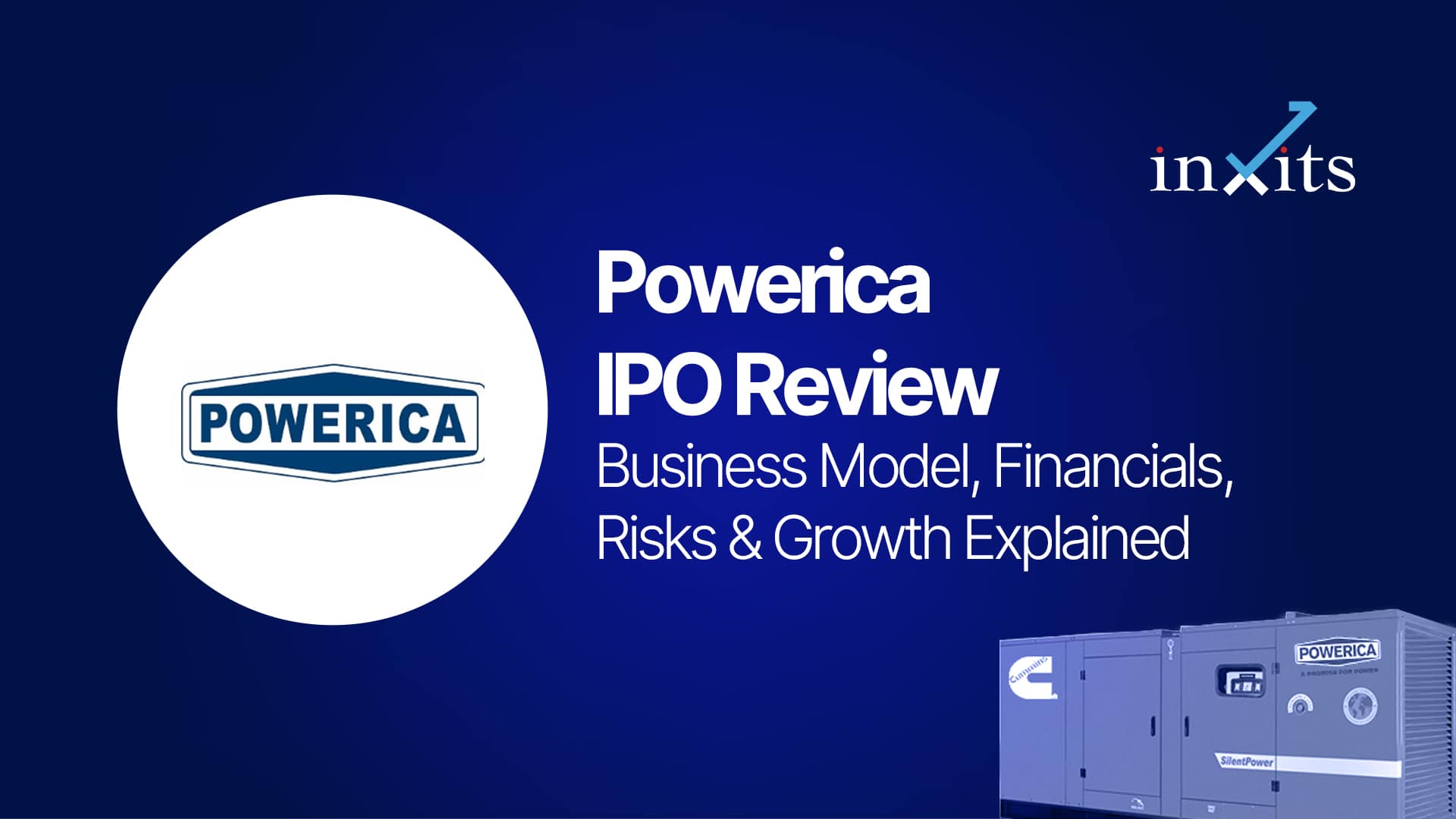
The Powerica IPO is one such example.
What Does Powerica Do?
Powerica operates across multiple stages of power solutions value chain with over 40 years of operating history.
The company operates across two main segments:
- Generator Set Business (core segment)
- Wind Power Business (growth segment)
This dual structure creates a mix of:
- Stable, demand-driven revenue
- Asset-based renewable energy income
Generator Set Business: The Core Revenue Driver
Powerica’s generator business has been active since 1984 and contributes 80–87% of total revenue.
Key Characteristics
- Authorized OEM partner for Cummins India
- Collaboration with HD Hyundai Heavy Industries
- Product range from 7.5 kVA to 10,000 kVA
These generators serve:
- Industrial facilities
- Commercial establishments
- Backup power needs
- Continuous power applications
The long-standing relationship with Cummins is a significant part of the business model.
However, this also creates a supplier concentration dynamic, where:
- Around 57–71% of revenue depends on Cummins-powered products
In practical terms, strong partnerships may provide stability, but dependence on a single supplier introduces exposure to pricing, supply disruptions, or contractual changes
Wind Power Business: The Growth Segment
The company entered the wind energy space in 2008 and operates through multiple roles:
- Independent Power Producer (IPP)
- EPC contractor
- O&M service provider
Revenue Streams
- Power generation income
- Project execution fees
- Maintenance contracts
This creates diversified income within the renewable segment.
Powerica IPO Details
- IPO Opening Date: 24 March
- IPO Closing Date: 27 March
- Allotment Date: 30 March
- Listing Date: 2 April
- Price Band: ₹375 – ₹394
- Lot Size: 37 shares
- Total Issue Size: ₹1,100 crore
Break-up:
- Fresh Issue: ₹700 crore
- Offer for Sale (OFS): ₹400 crore
Financial Snapshot: Stability with Variations
Reported Financials
| Period | Revenue (₹ Cr) | Profit (₹ Cr) |
| FY25 | 2,710.93 | 175.83 |
| H1 FY26 | 1,474.87 | 134.55 |
The company shows:
- Stable revenue trajectory
- Variability in profit trends
H1 FY26 profit appears relatively high compared to FY25 full-year profit, which may indicate:
- Seasonal trends
- Margin variations
Cash flows, however, remain relatively stable.
Balance Sheet Trends: What Stands Out
Declining PPE (Property, Plant & Equipment)
₹1,076.60 Cr (FY23) → ₹800.64 Cr (Sep 2025)
This may indicate:
- Asset depreciation
- Disposal of assets
Rising CWIP (Capital Work-in-Progress)
₹23.45 Cr → ₹429.30 Cr
This suggests ongoing capital expenditure where assets are under development.
Increase in Inventory
₹206.85 Cr → ₹315.11 Cr
This could indicate:
- Preparation for demand cycles
- Expansion-related stocking
Receivables Movement
Trade receivables remain elevated, which may reflect:
- Delayed collections
- Working capital intensity
Key Risks Investors Should Understand
Supplier Concentration Risk
Heavy reliance on Cummins creates:
- Dependency on a single OEM
- Exposure to supply and pricing changes
Legal Overhang
A civil suit filed in February 2026 challenges:
- Past family arrangements
- Shareholding structure
This may impact:
- Capital structure decisions
- Post-listing flexibility
Operational Risks in Wind Energy
O&M costs form 18–23% of wind revenue.
Land and Lease Risks
Some land leases are shorter than the duration of PPAs, which may create long-term uncertainty.
What Investors Usually Assume vs What Actually Happens
| Assumption | Reality |
| Power businesses are stable | Revenue depends on contracts & operations |
| Renewable energy is predictable | Performance & execution matter |
| Strong partnerships reduce risk | High dependence increases exposure |
| Large revenue = strong position | Balance sheet & cash flow matter |
How inXits Helps Bring Clarity to Complex IPOs
IPO evaluation becomes challenging when multiple business segments are involved.
inXits supports investors by:
- Simplifying business structures
- Interpreting financial trends
- Aligning investments with portfolio strategy
Connect with inXits for a 24×7 consultation focused on financial planning and portfolio review processes.
Conclusion
The Powerica IPO reflects a combination of:
- A long-standing generator business
- A renewable energy segment
While the company benefits from:
- Established OEM relationships
- Multiple revenue streams
It also operates within a structure involving:
- Supplier concentration
- Legal uncertainties
- Operational risks
Understanding these factors helps investors build a clearer perspective beyond initial assumptions.
FAQs
1. What does Powerica primarily do?
It provides power solutions through generator sets and wind energy operations.
2. What is the company’s main revenue source?
The generator set business contributes the majority of revenue.
3. What is the role of Cummins in the business?
Cummins is a key OEM partner supplying engines.
4. What is an IPP?
An Independent Power Producer owns and operates power assets.
5. Why is CWIP important?
It reflects ongoing investments for future growth.
6. What risks exist in renewable energy?
Operational and execution-related risks.
7. What is supplier concentration?
Dependence on a single supplier.
8. Why are legal disputes important?
They may impact governance and decisions.
9. How does working capital affect business?
It impacts cash flow and operations.
10. How should investors evaluate such companies?
By analyzing each segment separately.
📘 Disclaimer
Investment in securities market are subject to market risks. Read all related documents carefully before investing.
Registration granted by SEBI, membership of BSE and certification from NISM do not guarantee performance or returns.
The securities quoted are for illustration only and are not recommendatory.