 AI Summary
The SIP vs PPF debate is not about choosing a winner, but understanding how two very different financial tools serve different purposes. SIPs offer market-linked growth potential, flexibility, and liquidity through mutual fund investing, while PPF provides government-backed stability, tax benefits, and long-term disciplined savings through a 15-year structure. The article explains that SIPs may suit investors seeking growth and inflation-beating returns, whereas PPF may appeal to those prioritizing capital protection and predictable savings. The key takeaway is that the right choice depends on an individual's financial goals, risk tolerance, time horizon, and liquidity needs—and for many investors, a combination of both can create a more balanced long-term financial plan.
When planning long term savings, many Indian investors face a common question: Should I invest through SIP or put money in PPF?
This situation often comes up during key life stages such as starting a new job, planning retirement, or saving for a child’s future. Family members may suggest PPF for stability, while peers may discuss SIPs for growth.
Without clarity on structure, risk, taxation, and liquidity, decisions may end up based on partial understanding.
A structured view of SIP vs PPF helps align choices with financial goals and risk comfort.
On this page
What Does SIP vs PPF Mean?
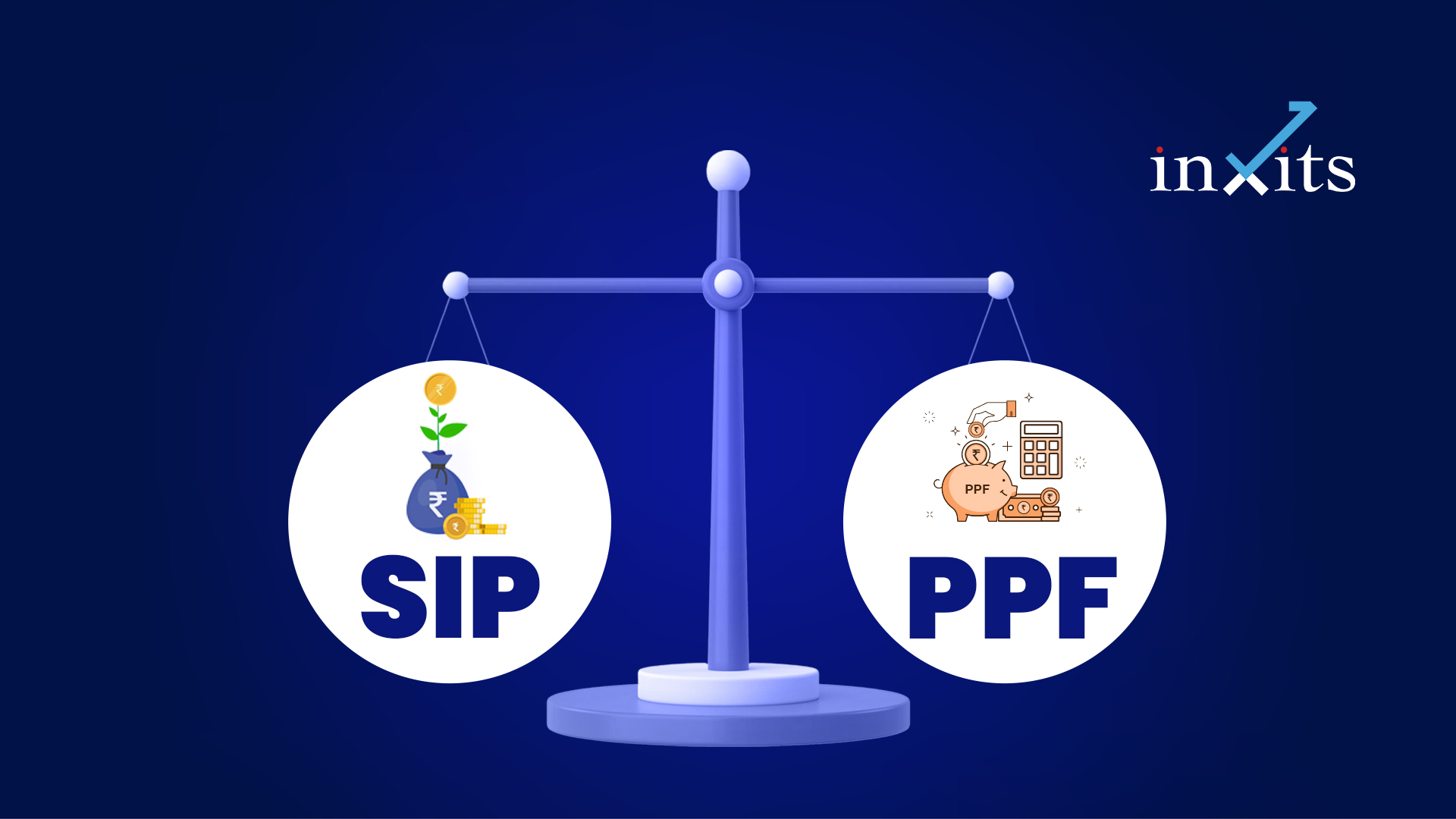
SIP vs PPF compares two fundamentally different approaches to long term investing.
What is a SIP?
A Systematic Investment Plan allows investors to invest a fixed amount regularly in mutual funds.
If you want to understand how this works in detail, exploring how SIP works and its benefits gives useful clarity.
Example:
- ₹5,000 per month in an equity mutual fund
- ₹3,000 per month in a hybrid fund
- ₹10,000 split across multiple funds
SIP is not a product. It is a method of investing.
What is PPF?
Public Provident Fund is a government-backed long term savings scheme.
Key features:
- 15-year lock-in period
- Interest rate declared periodically
- Tax benefit under Section 80C
- EEE tax status under current rules
PPF is a defined product with fixed rules and structure.
SIP vs PPF: Key Structural Differences
| Feature | SIP | PPF |
| Type | Investment method | Government savings scheme |
| Returns | Market-linked | Fixed interest |
| Risk | Depends on fund | Low |
| Lock-in | Usually none (except ELSS) | 15 years |
| Liquidity | Flexible redemption | Limited withdrawals |
| Tax | Capital gains tax | EEE tax benefit |
This table highlights that SIP vs PPF is not a like-for-like comparison, but a comparison of structure and purpose.
How Do Risk Levels Differ in SIP vs PPF?
Risk is one of the most important differences between SIP and PPF.
Risk in SIP
When investing through SIP:
- Returns depend on market performance
- Portfolio value may fluctuate
- Short term volatility can be high
Even in debt funds, returns depend on interest rates and credit quality.
Understanding types of mutual funds in India helps clarify how risk varies across categories.
SIP spreads investment over time, but it does not remove market risk.
Risk in PPF
PPF is a government-backed savings scheme, and capital is protected under the scheme rules.
- Interest rates are declared periodically
- Capital is protected under scheme framework
- Returns do not fluctuate daily
However, interest rates can change over time.
In simple terms, SIP vs PPF compares market-linked variability with fixed-income stability.
How Does Return Structure Differ?
Returns play a central role in decision-making.
SIP Returns
SIP returns depend on:
- Type of mutual fund
- Market cycles
- Expense ratio
- Investment duration
Equity funds may show fluctuations across years, while debt funds depend on interest rate trends.
These are general illustrations. The securities quoted are for illustration only and are not recommendatory.
PPF Returns
PPF provides:
- Government-declared interest rates
- Annual compounding
- Tax-free maturity under current rules
The rate is revised periodically, not fixed for the entire tenure.
Thus, SIP vs PPF differs in both return generation and variability.
Lock-in and Liquidity Comparison
Liquidity becomes important when financial needs change.
PPF Lock-in Rules
- 15-year maturity period
- Partial withdrawal allowed after specific years
- Loan facility within defined limits
- Extension in 5-year blocks
Premature closure is restricted to specific conditions.
SIP Liquidity
- Mutual funds can be redeemed anytime
- Exit load may apply for a short duration
- No long-term lock-in in most funds
If you compare flexibility further, understanding SIP vs lump sum also helps in decision-making.
Liquidity is where SIP and PPF differ significantly.
Taxation: SIP vs PPF
Taxation often influences investor preference.
Invest Smarter.
Grow Confidently.
Your AI-powered SEBI-registered investment advisor — with research you can trust and insights that grow with you.
Download inXits Free
PPF Tax Treatment
- Eligible for Section 80C deduction
- Interest is tax-free
- Maturity proceeds are tax-free
Tax rules may change as per government regulations.
SIP Tax Treatment
Depends on:
- Type of mutual fund
- Holding period
- Capital gains tax rules
Unlike PPF, SIP investments qualify for tax deduction only in specific cases like ELSS.
Goal-Based Suitability in SIP vs PPF
Different goals require different financial tools.
Retirement Planning
PPF may suit long-term stability due to:
- Long tenure
- Structured savings
- Compounding
However, retirement planning may also require growth-oriented assets.
Child Education Planning
For long-term goals:
- PPF provides stability
- SIP offers growth potential
The allocation depends on risk comfort.
Emergency Fund
Neither SIP in equity nor PPF typically suits emergency funds due to volatility and lock-in.
Inflation Consideration in SIP vs PPF
Inflation impacts long-term purchasing power.
- PPF returns may be affected if inflation rises above interest rate
- Equity investments may participate in economic growth, but fluctuate
These are general observations. The securities quoted are for illustration only and are not recommendatory.
Balancing inflation and stability is part of structured planning.
Behavioural Aspects
Investor behaviour often influences outcomes more than product choice.
Behaviour in SIP
- Investors may stop during market declines
- Some increase investments during bull markets
- Emotions can impact consistency
Behaviour in PPF
- Lock-in enforces discipline
- Limited liquidity prevents impulsive withdrawals
- Less flexibility in emergencies
Understanding behaviour helps align decisions with long-term consistency.
When SIP May Be Considered
SIP may be considered in situations such as:
- Long-term financial goals
- Comfort with market volatility
- Focus on growth and inflation-adjusted returns
When PPF May Be Considered
PPF may be considered in situations such as:
- Conservative risk profile
- Need for tax-efficient savings
- Long-term capital stability
Can SIP and PPF Be Used Together?
SIP vs PPF does not always mean choosing one over the other.
Many investors combine both.
Example allocation
- PPF for stability
- SIP in equity funds for growth
For instance:
- 60% in equity funds via SIP
- 40% in PPF
This is only a hypothetical illustration. The securities quoted are for illustration only and are not recommendatory.
Allocation depends on:
- Risk tolerance
- Age
- Income stability
- Existing investments
How inXits Supports Structured Planning
SIP vs PPF decisions often feel confusing due to mixed advice and partial information.
inXits follows a structured approach focusing on:
- Risk profiling
- Goal-based allocation
- Portfolio review
- Tax-aware planning
Instead of isolating one option, the focus remains on overall financial structure.
Conclusion: SIP vs PPF Requires Context
SIP vs PPF compares a market-linked investment method with a government-backed savings scheme.
SIP offers flexibility and growth potential with volatility. PPF provides stability, tax benefits, and long-term discipline.
The right choice depends on goals, risk tolerance, time horizon, and liquidity needs.
Instead of treating SIP vs PPF as a competition, evaluating how both fit into overall financial planning leads to better decisions.
If you want to align these choices with your financial goals, exploring personalized financial planning can provide structured clarity.
Disclaimer
Investment in securities market are subject to market risks. Read all the related documents carefully before investing.
Registration granted by SEBI, membership of BSE and certification from NISM in no way guarantee performance of the intermediary or provide any assurance of returns to investors.
The securities quoted are for illustration only and are not recommendatory.
Understand What Fits You Best
Book a Consultation
Himani Barot, CFP, is a Principal Officer at inXits with 4+ years of experience in portfolio management, investment advisory, and comprehensive financial planning. As a Certified Financial Planner, she helps clients navigate complex financial goals with structured, personalised strategies.
FAQs
1. What is the basic difference between SIP vs PPF?
SIP is a method of investing in mutual funds, while PPF is a government-backed savings scheme.
2. Is PPF safer than SIP?
PPF is government-backed, while SIP depends on market-linked investments.
3. Can investors invest in both SIP and PPF?
Yes, many investors use both based on goals and risk comfort.
4. Does SIP offer guaranteed returns?
No, returns depend on market performance.
5. Is PPF completely tax-free?
Under current rules, PPF enjoys EEE tax status, subject to change.
6. Which is better for long term goals?
It depends on financial goals and risk tolerance.
7. Can PPF be withdrawn before 15 years?
Partial withdrawals are allowed under specific conditions.
8. Does SIP have a lock-in period?
Most funds do not have long lock-ins except ELSS.
9. How does inflation affect SIP vs PPF?
Inflation may reduce fixed returns, while equity may fluctuate but aim for growth.
10. How should investors choose between SIP vs PPF?
By evaluating goals, risk comfort, tax needs, and liquidity.