Many mutual fund investors feel confused when they see returns written as a single yearly number. Markets move up and down, investments happen over time, and results rarely follow a straight line. Still, fund factsheets often show one clean percentage. This gap between real movement and simple reporting leads to questions.
CAGR in mutual funds solves this confusion by showing the average yearly growth of an investment over a fixed period. It helps investors compare funds, time periods, and goals using one steady number. This guide explains the meaning of CAGR, how to calculate it, when it works well, and when it does not.
By the end, you will know how to read mutual fund returns with more clarity and fewer assumptions.
What is CAGR in mutual funds?
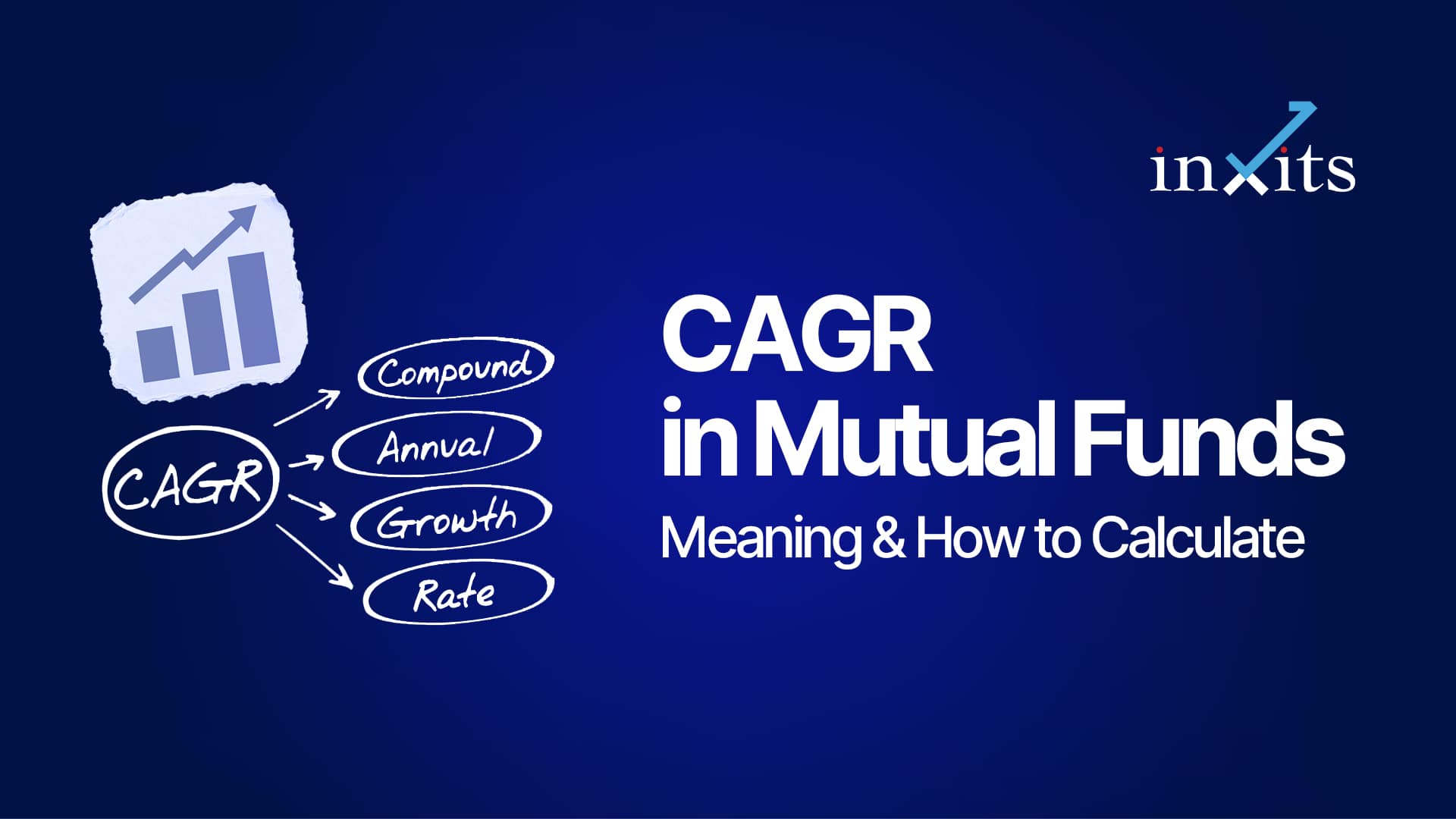
CAGR in mutual funds means Compounded Annual Growth Rate. It shows the average yearly growth of an investment assuming profits are added back every year.
Instead of showing actual ups and downs, CAGR smooths the journey into a single growth rate. This makes it easier to compare different mutual funds or time periods.
Before going deeper, it helps to understand what CAGR is designed to show.
- It assumes the investment grows at a steady rate every year
- It includes the effect of compounding
- It ignores yearly volatility
- It works best for lump sum investments
In simple words, CAGR answers one question. If my investment grew at the same rate every year, what would that rate be?
This makes CAGR a reporting tool, not a prediction tool.
Why CAGR is used for mutual fund returns
Mutual funds do not grow evenly. One year may give strong gains, another year may fall, and a third year may stay flat. Showing each year separately makes comparison hard.
CAGR is used because it simplifies long-term performance into a single number that investors can understand quickly.
Here is why fund houses and advisors rely on it.
- It allows easy comparison between two funds
- It works well for long holding periods
- It reflects compounding over time
- It avoids short-term noise
After looking at these points, it becomes clear that CAGR is not about daily accuracy. It is about long-term direction.
CAGR formula explained in simple terms
The CAGR formula looks complex at first, but the logic is simple. It measures how much an investment grew from start to end and spreads that growth evenly across years.
The formula is:
Final value ÷ Initial value
Raised to the power of 1 ÷ number of years
Minus 1
To understand this better, break it into steps.
- Take the ending value of your investment
- Divide it by the starting value
- Find how many years you stayed invested
- Apply the formula
This process converts uneven growth into one yearly rate. That rate is CAGR.
How to calculate CAGR with an example
Let us look at a simple example to make CAGR clear.
Suppose you invested ₹1,00,000 in a mutual fund. After 5 years, the value became ₹2,00,000.
Here is how the calculation works.
- Initial value = ₹1,00,000
- Final value = ₹2,00,000
- Time period = 5 years
Using the CAGR formula, the result comes close to 14.9 percent per year.
This does not mean the fund gave exactly 14.9 percent every year. It means the final growth matches what a steady 14.9 percent yearly rise would produce.
CAGR vs absolute returns
Many investors confuse CAGR with absolute returns. Both measure performance, but they answer different questions.
Absolute return shows total gain without considering time. CAGR adjusts returns based on how long the investment stayed invested.
Here is how they differ.
- Absolute return ignores time
- CAGR includes time
- Absolute return suits short periods
- CAGR suits long periods
After comparing the two, it becomes clear that CAGR gives more context when time matters.
When CAGR works well
CAGR is most useful in certain situations. Knowing these helps avoid wrong conclusions.
CAGR works best when:
- The investment is a lump sum
- The holding period is more than three years
- The goal is comparison, not prediction
- Market cycles are included
When these conditions exist, CAGR gives a clean and fair picture of growth.
Limitations of CAGR in mutual funds
While CAGR is helpful, it does not tell the full story. Investors should know its limits before relying on it alone.
Here are key limits to keep in mind.
- It hides yearly ups and downs
- It does not show risk
- It does not suit SIP returns
- It assumes smooth growth
Because of these limits, CAGR should always be read along with other data like rolling returns and drawdowns.
CAGR vs XIRR for SIP investors
Most mutual fund investors use SIPs. CAGR does not work well for SIPs because money is invested at different times.
This is where XIRR comes in.
- CAGR suits one-time investments
- XIRR suits multiple cash flows
- XIRR reflects timing of each SIP
- CAGR ignores cash flow timing
If you invest through SIPs, XIRR gives a more accurate picture than CAGR.
How investors should use CAGR correctly
CAGR becomes useful only when used with the right mindset. It should guide understanding, not replace judgment.
Here is how investors can use CAGR wisely.
- Compare funds within the same category
- Use similar time periods
- Check risk measures alongside
- Avoid short-term comparisons
Once used this way, CAGR becomes a helpful filter rather than a decision-maker.
Role of guidance when CAGR feels confusing
Many first-time investors struggle to connect CAGR numbers with real outcomes. Reading formulas is one thing, applying them is another.
If market research feels confusing or return numbers do not make sense, speaking to a mutual fund advisor can help.
Some investors prefer informal guidance before making choices. In such cases, teams like inXits offer free consulting support where concepts like CAGR, XIRR, and fund comparisons are explained in simple language. This kind of support can help investors read data with more confidence, without pressure to act.
Key takeaways
CAGR in mutual funds helps investors understand long-term growth using one steady number. It works best for lump sum investments and long holding periods. It does not show risk or yearly movement, so it should never be used alone. When return numbers feel hard to read, basic guidance can help bridge the gap.
Used the right way, CAGR becomes a useful lens rather than a misleading shortcut.
FAQs on CAGR in mutual funds
What does CAGR mean in mutual funds?
CAGR in mutual funds means the average yearly growth rate of an investment over a fixed period, assuming compounding.
Is CAGR the same as yearly return?
No, CAGR smooths returns into one rate, while yearly return shows actual performance for each year.
Can CAGR be negative?
Yes, CAGR can be negative if the final investment value is lower than the starting value.
Is CAGR good for SIP investments?
No, CAGR is not suitable for SIPs. XIRR should be used instead.
Why do mutual funds show CAGR?
Mutual funds show CAGR to present long-term performance in a simple and comparable way.
Does CAGR show risk?
No, CAGR does not show volatility or downside risk. It only shows growth rate.
How many years are ideal for CAGR analysis?
Three years or more gives a better picture when using CAGR.
Can two funds have the same CAGR?
Yes, two funds can have the same CAGR even if their yearly returns differ.
Is higher CAGR always better?
Not always. Higher CAGR without understanding risk can lead to poor choices.
Should beginners rely only on CAGR?
No, beginners should use CAGR along with guidance, fund goals, and risk comfort.
SEBI Warning & Disclaimer
Mutual fund investments are subject to market risks. Read all scheme related documents carefully before investing. The information provided in this article is for educational purposes only and should not be considered as investment advice, recommendation, or opinion. Past performance is not indicative of future returns. Investors should consult a registered mutual fund advisor before making any investment decision.