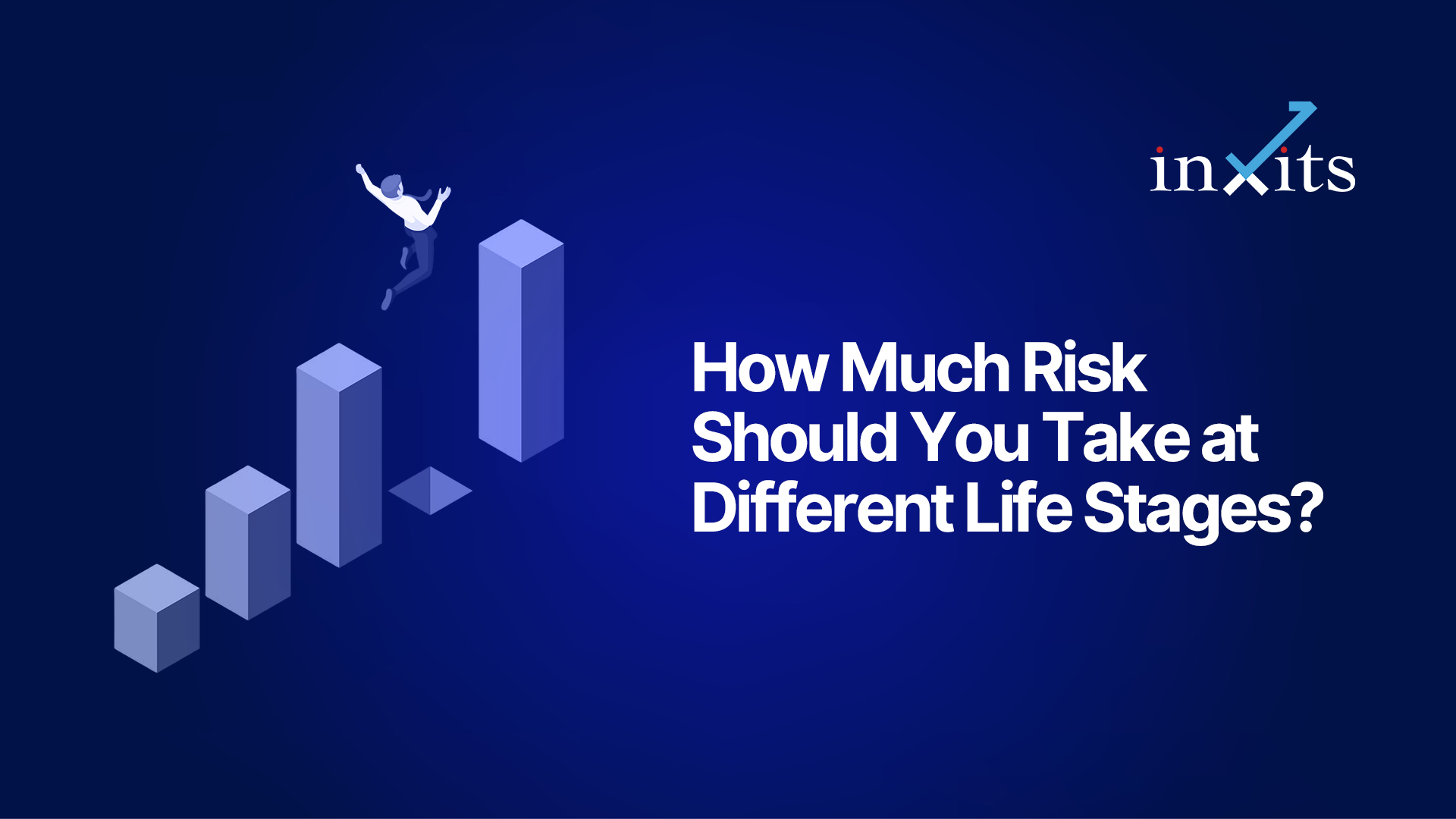
A 25-year-old professional investing for retirement and a 60-year-old retiree depending on investment income face very different financial realities. Yet many investors ask the same question:
On this page
How much risk should you take?
It depends on three things: your risk tolerance (how much volatility you can emotionally handle), your risk capacity (how much loss you can financially absorb without derailing goals), and your investment horizon (how long before you need the money). All three change at every life stage, which is why a 25-year-old and a 60-year-old need fundamentally different portfolio structures even if they ask the same question.
The confusion is understandable. Financial markets constantly discuss risk, returns, and portfolio allocation. However, risk is not a fixed number that applies equally to everyone. It changes as your income grows, responsibilities increase, goals evolve, and retirement approaches.
Many investors feel uncertain because they worry about making a costly mistake. Taking too much risk can expose a portfolio to unnecessary volatility. Taking too little risk can make it harder to achieve long-term financial goals.
The right answer depends on your life stage, financial obligations, investment horizon, and ability to recover from setbacks. Understanding these factors can help you make more informed decisions rather than relying on generic rules.
How Much Risk Should You Take: Key Takeaways
Risk capacity changes throughout life.
- Younger investors often have a longer recovery period after market declines.
- Mid-career investors usually balance growth with increasing responsibilities.
- Pre-retirement investors often focus more on capital preservation.
- Retirement portfolios still need growth, but with greater stability.
- Financial goals matter more than age alone. SEBI’s guidelines for registered investment advisers specifically require risk profiling based on risk capacity, risk tolerance, and risk appetite before any portfolio recommendation—not age alone.
Source: SEBI (Investment Advisers) Regulations, 2013
Why Does Risk Tolerance Change Over Time?
Risk tolerance is the amount of uncertainty an investor can comfortably handle. Risk capacity is the ability to withstand financial setbacks without affecting important goals.
Both factors evolve throughout life.
SEBI’s Investment Advisers Regulations, 2013 specifically require advisers to assess three dimensions of risk before making any recommendation: risk capacity (financial ability to absorb loss), risk tolerance (emotional comfort with volatility), and risk appetite (willingness to take risk for return). All three can differ significantly for the same investor at different life stages.
Source: SEBI (Investment Advisers) Regulations, 2013
A young professional with stable income and limited obligations can usually tolerate temporary market declines more easily than someone nearing retirement. Meanwhile, a parent funding children’s education may have different priorities than someone building wealth for the first time.
Therefore, effective investing involves matching portfolio risk to both emotional comfort and financial reality.
Is Age the Only Factor That Determines Risk?
No. Age is important, but it is not the only consideration.
Several factors influence risk decisions:
- Income stability
- Emergency savings
- Existing assets
- Financial dependents
- Investment goals
- Time horizon
- Debt obligations
For example, a 45-year-old entrepreneur with substantial assets may have greater risk capacity than a 30-year-old carrying significant debt and limited savings.
How Much Risk Should You Take in Your 20s and Early 30s?
Investors in their 20s and early 30s generally have the longest investment horizon. Because retirement may be decades away, they often have more time to recover from market downturns.
As a result, growth-oriented investments frequently play a larger role during this stage.
A young salaried employee in Bengaluru investing for retirement may not need access to those funds for another 30 or 35 years. Short-term volatility may feel uncomfortable, but the long time horizon often provides flexibility.
Common Priorities During This Stage
- Building an emergency fund.
- Starting long-term investments.
- Managing education loans or other debt.
- Developing investment discipline.
- Increasing savings rates as income grows.
Many investors also benefit from learning basic asset allocation principles early. Tools such as a SIP calculator can help estimate how consistent investments may support future goals.
Also read: How SIP works
What Investors Often Get Wrong
Many young investors assume a long time horizon justifies maximum risk, concentrating in a few stocks, investing in speculative assets, or borrowing to invest.
In practice, diversification matters at every age. A long horizon gives you time to recover from market declines, but it does not protect you from the permanent loss that comes from poor investment quality or excessive concentration.
How Much Risk Should You Take in Your 40s and 50s?
This stage often brings the highest financial responsibilities.
Children’s education, home loans, ageing parents, and retirement planning frequently compete for attention. At the same time, earnings may be at their highest level.
Many investors begin shifting from pure wealth accumulation toward balancing growth and protection.
Key Questions to Consider
- How many years remain until retirement?
- Are major financial goals funded?
- How dependent are future plans on portfolio growth?
- Is the portfolio diversified across asset classes?
A balanced allocation often becomes more relevant during this stage. Some investors increase exposure to fixed-income instruments alongside equities.
Those seeking structured guidance on balancing growth and stability often work with a fixed income advisor when evaluating debt instruments as part of a broader portfolio strategy.
A Practical Example
Consider Rajesh, a 47-year-old manager in Pune. He has a home loan, two children approaching university, and retirement planned in 13 years.
A portfolio built entirely around aggressive growth investments may expose him to unnecessary risk if markets decline shortly before major financial milestones. A diversified approach can help align investments with multiple goals occurring at different times.
Before making major allocation decisions, it helps to understand how risk capacity has changed since earlier stages of life.
If you are unsure whether your portfolio still reflects your current goals and responsibilities, a financial advisor can help assess whether your asset allocation remains appropriate for your life stage.
How Much Risk Should You Take Near Retirement?
Investors approaching retirement often become more concerned about capital preservation.
The reason is simple. The ability to recover from a major market decline becomes more limited as retirement nears.
However, reducing all market exposure may not always be appropriate.
Invest Smarter.
Grow Confidently.
Your AI-powered SEBI-registered investment advisor — with research you can trust and insights that grow with you.
Download inXits Free
Should Investors Avoid Equity Completely Before Retirement?
Not necessarily.
Retirement may last 20 to 30 years or longer. Therefore, portfolios often still require some growth-oriented assets to help address inflation.
The objective usually shifts from maximising growth to balancing growth with stability.
Key Facts on Retirement Risk
- Inflation can reduce purchasing power over long periods.
- Retirement portfolios may need to support income for decades.
- Asset allocation often becomes more important than return forecasting.
- Diversification can help manage sequence-of-return risk.
Investors focused on long-term retirement preparation frequently evaluate retirement planning services to align investment strategy with future income requirements.
How Much Risk Should You Take After Retirement?
Retirement does not eliminate risk. Instead, the nature of risk changes.
Many retirees focus on preserving capital and generating sustainable income. However, avoiding all growth assets can create challenges if inflation outpaces portfolio growth.
What Risks Matter Most in Retirement?
The most common risks include:
- Inflation risk.
- Longevity risk.
- Withdrawal risk.
- Concentration risk.
- Healthcare expense risk.
Life expectancy in India has risen significantly, from approximately 60 years in the 1990s to over 70 years today according to World Bank data. A retiree at 60 may need their corpus to last 25–30 years, making longevity risk—the risk of outliving your money—as important as market risk.
Source: World Bank – India Life Expectancy Data
A retiree depending entirely on low-yield instruments may face purchasing power challenges over time. Therefore, many retirement portfolios maintain a combination of income-producing and growth-oriented assets.
How Often Should Retirees Review Risk?
Regular reviews become increasingly important.
Changes in healthcare needs, spending patterns, family circumstances, and market conditions can affect portfolio requirements. Periodic assessments help ensure investments continue supporting retirement objectives.
How Can Investors Build a Risk Framework for Every Life Stage?
The most effective risk framework focuses on goals rather than age alone.
Instead of asking, “How much risk should someone my age take?” consider asking:
- What am I investing for?
- When will I need the money?
- How stable is my income?
- What responsibilities do I have?
- How would a market decline affect my plans?
A structured approach often provides greater clarity than reacting to market headlines.
For example, investors who use a combination of goal-based planning, diversification, and regular portfolio reviews generally find it easier to stay disciplined during market volatility.
How inXits Helps Investors Align Risk with Life Goals
Understanding how much risk should you take is not simply about selecting aggressive or conservative investments. The more important task is matching risk to specific financial objectives.
At inXits, advisors help investors evaluate risk capacity, investment timelines, asset allocation, and goal priorities. Rather than relying on broad age-based rules, the focus remains on creating a portfolio structure aligned with individual circumstances.
Many investors wonder whether they are taking too much risk, too little risk, or the wrong type of risk altogether. Those questions often become more important as financial responsibilities increase.
A discussion with a SEBI registered financial advisor can help identify gaps between current portfolio positioning and long-term financial objectives.
Conclusion
The answer to how much risk should you take depends on far more than your age. Financial goals, investment horizon, income stability, responsibilities, and personal circumstances all influence appropriate risk levels.
Investors in their 20s often have greater flexibility to tolerate market volatility. Mid-career investors frequently balance growth with growing obligations. Those nearing retirement generally place greater emphasis on protecting accumulated wealth while maintaining enough growth to address inflation.
The most successful risk decisions usually come from understanding your financial objectives rather than reacting to market movements. As life evolves, your investment strategy should evolve as well.
If you would like an independent assessment of whether your portfolio’s risk level matches your current life stage and goals, connecting with an investment advisor can provide greater clarity and structure for future decisions.
FAQ
How much risk should you take in your 20s?
Investors in their 20s often have longer investment horizons, which may allow greater exposure to growth-oriented assets. However, diversification and financial goals remain important considerations.
How much risk should you take in your 40s?
Investors in their 40s frequently balance growth objectives with family responsibilities, debt obligations, and retirement planning. Asset allocation often becomes increasingly important during this stage.
How much risk should you take before retirement?
Risk exposure often becomes more balanced before retirement. The focus typically shifts toward preserving capital while maintaining enough growth potential to address inflation.
Is age the most important factor when determining investment risk?
No. Income stability, financial obligations, investment goals, assets, liabilities, and time horizon often influence risk decisions as much as age.
Can retirees invest in equities?
Many retirees maintain some equity exposure to help address inflation and long retirement periods. The appropriate allocation depends on individual circumstances and income needs.
What is risk capacity in investing?
Risk capacity refers to an investor’s financial ability to absorb losses without significantly affecting important goals or lifestyle requirements.
How often should investors review their risk profile?
Many investors review their risk profile annually or after major life events such as marriage, parenthood, career changes, or approaching retirement.
How is investment risk regulated in India?
The Securities and Exchange Board of India (SEBI) regulates investment intermediaries and market participants. However, regulation does not remove investment risk, making suitability and diversification important considerations.
Disclaimer
Investments in securities markets are subject to market risks. Read all related documents carefully before investing.
inXits is a SEBI-registered investment adviser (Registration No. INA000020369). This article is for educational purposes only and does not constitute personalised investment advice.
Registration granted by SEBI, membership of BSE, and certification from NISM in no way guarantee performance of the intermediary or provide any assurance of returns to investors.

Himani Barot, CFP, is a Principal Officer at inXits with 4+ years of experience in portfolio management, investment advisory, and comprehensive financial planning. As a Certified Financial Planner, she helps clients navigate complex financial goals with structured, personalised strategies.