Many investors come across IPOs from traditional businesses like food processing or exports and feel a sense of familiarity. Rice, for example, is something people understand in daily life. However, when that same product becomes part of a listed business, the dynamics can feel very different.
There is often a gap between what investors assume — “it’s a known product, so the business must be simple” — and how the business actually operates at scale.
The Amir Chand IPO is one such case.
While it is rooted in a well-known category like basmati rice, the company operates across exports, branding, distribution, and supply chains. This blog breaks down how the business works, what the financials indicate, and what risks exist — in a structured and easy-to-follow way.
What Does Amir Chand Do?
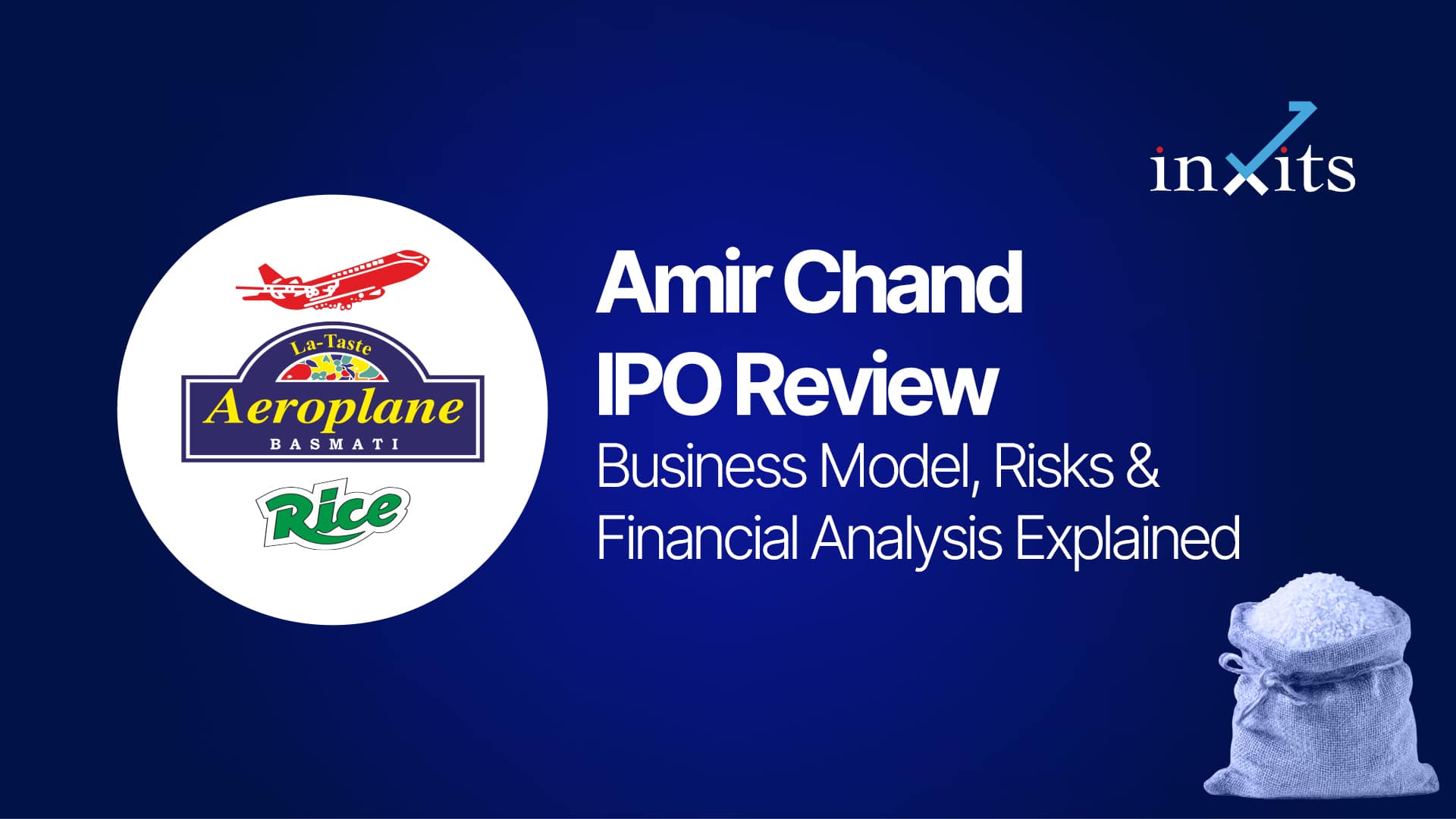
Amir Chand is a fully integrated basmati rice processor and exporter with over 40 years of industry experience.
Being “integrated” means the company operates across multiple stages of the value chain:
- Procurement of paddy
- Processing and milling
- Branding and packaging
- Distribution and export
The company sells its products under the “Aeroplane” brand, supported by more than 40 sub-brands across different price segments.
Additionally, the company has:
- 100+ registered trademarks
- Presence across 26+ countries
This gives it both brand recognition and geographic reach.
How Has the Business Expanded Beyond Rice?
While basmati rice remains the core product, the company has expanded into:
- Aata
- Besan
- Salt
This reflects a common FMCG strategy — leveraging existing distribution to introduce adjacent products.
However, new categories typically:
- Take time to scale
- Contribute smaller revenue initially
Over time, this diversification may reduce dependency on a single product.
Understanding the Global Presence
Amir Chand exports to over 26+ countries, with a strong presence in:
- Europe
- Middle East
- Africa
The Middle East contributes around 14% of total revenue.
Export-driven businesses often rely heavily on key regions:
- Stable regions support growth
- Regional disruptions can impact demand quickly
This makes geographic concentration an important factor.
Amir Chand IPO Details
| Feature | Details |
| IPO Dates | 24 March – 27 March 2026 |
| Price Band | ₹201 – ₹212 per share |
| Issue Size | ₹440 Crore (Fresh Issue) |
| Market Lot | 70 Shares (₹14,840) |
| Listing At | BSE & NSE |
Financial Snapshot: What the Numbers Indicate
Reported Financials
| Period | Revenue (₹ Cr) | Profit (₹ Cr) |
| FY25 | 2004.03 | 60.82 |
| H1 FY26 | 1024.30 | 48.65 |
The company operates at a relatively larger scale compared to many SME businesses, with consistent revenue generation.
However, two important aspects stand out:
1. Volatile Cash Flow from Operations
The company has experienced fluctuations in cash flow from operations (CFO) due to working capital changes.
In businesses like rice processing, working capital is influenced by:
- Seasonal procurement of paddy
- Inventory holding
- Payment cycles from distributors
This means profits may appear stable, while actual cash movement varies.
2. Reduction in Borrowings
The company has reduced its borrowings over time.
From an educational perspective, this may indicate:
- Improved balance sheet management
- Lower financial obligations
However, investors typically look at debt alongside other factors such as cash flow and operational efficiency.
Key Risks Investors Should Understand
Dependence on Basmati Rice
A large portion of revenue still comes from basmati rice and related products.
If demand or pricing in this category changes, it may affect overall performance.
Geographic Revenue Concentration
With around 14% revenue from the Middle East, any:
- Economic slowdown
- Regulatory change
- Trade restriction
in that region could impact business outcomes.
Customer Concentration Risk
The company relies on a limited number of:
- Large customers
- Distributors
Losing or underperforming key accounts can affect revenue stability.
Lack of Long-Term Contracts
Many relationships do not involve long-term agreements.
This creates uncertainty in:
- Future order volumes
- Revenue predictability
In real-life terms, this is similar to running a business where repeat customers are important, but not contractually guaranteed.
Procurement Dependency
The company depends on procurement agents without long-term agreements.
Challenges may arise in:
- Securing quality paddy
- Managing price fluctuations
- Ensuring timely supply
Debt Levels
The company has a debt-to-equity ratio of 1.68, which indicates meaningful indebtedness.
Higher debt levels may:
- Increase sensitivity to interest rates
- Affect refinancing conditions
What Investors Usually Assume vs What Actually Happens
Assumption: Everyday products mean simple business
Reality: Supply chains, exports, and pricing cycles add complexity
Assumption: Strong brand ensures stable revenue
Reality: Distribution, competition, and contracts influence outcomes
Assumption: High revenue means strong cash flow
Reality: Working capital-heavy businesses may show cash flow fluctuations
Assumption: Export diversification reduces risk
Reality: Revenue concentration in key regions still matters
Understanding these differences helps investors move from surface-level comfort to deeper clarity.
How inXits Helps Simplify Such IPO Understanding
IPO analysis often involves multiple moving parts — business model, financials, risks, and external factors.
inXits supports investors by:
- Breaking down complex business structures into simple insights
- Helping interpret financial patterns like working capital and cash flow
- Providing clarity on how new opportunities fit within an overall portfolio
Connect with inXits for a 24×7 consultation focused on financial planning and portfolio review processes, acting as a personal CFO for structured understanding.
Conclusion
The Amir Chand IPO represents a traditional business evolving into a branded and export-driven FMCG player.
While the company has:
- Long industry experience
- Established brand presence
- Expanding product categories
it also operates within a structure that involves:
- Working capital intensity
- Export dependencies
- Customer concentration risks
For investors, understanding how these elements interact in real-life scenarios can provide more clarity than focusing only on IPO timelines or brand familiarity.
A structured, informed approach often helps in interpreting such opportunities with greater confidence.
FAQs
1. What does Amir Chand primarily do?
It is a basmati rice processor and exporter with operations across the value chain and presence in multiple countries.
2. What products does the company offer beyond rice?
The company has expanded into FMCG staples like aata, besan, and salt.
3. What is the significance of working capital in this business?
Working capital affects inventory, procurement, and cash flow cycles, especially in seasonal industries.
4. Why is geographic concentration important?
Revenue dependence on specific regions can expose the business to regional economic or regulatory changes.
5. What does debt-to-equity ratio indicate?
It shows the proportion of debt relative to equity, helping assess financial leverage.
6. Why are long-term contracts important?
They provide revenue visibility and reduce uncertainty in future business operations.
7. What risks exist in procurement-based industries?
Challenges include price volatility, supply consistency, and quality control.
8. How should investors view export-driven companies?
They can consider both global opportunities and associated operational complexities.
9. What role does brand play in such businesses?
Brand helps in market positioning, but distribution and pricing still influence sales.
10. Why is cash flow analysis important alongside profit?
Cash flow reflects actual liquidity and operational efficiency, beyond accounting profits.
📘 Disclaimer
Investment in securities market are subject to market risks. Read all the related documents carefully before investing.
Registration granted by SEBI, membership of BSE and certification from NISM in no way guarantee performance of the intermediary or provide any assurance of returns to investors.
The securities quoted are for illustration only and are not recommendatory.