
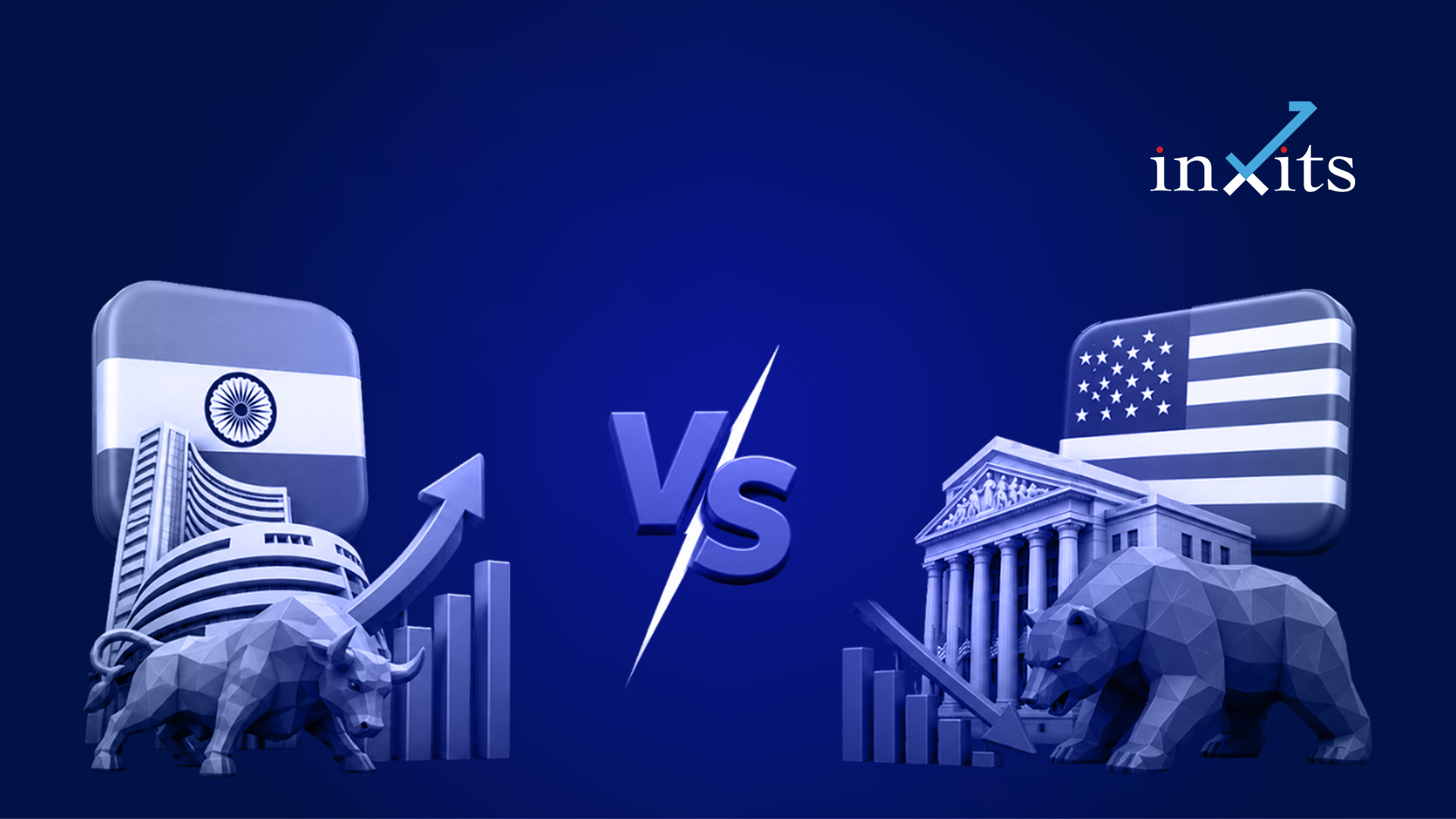
Many investors reach a point where they ask a simple but important question: should their money stay entirely in Indian markets, or should some of it be invested overseas?
The question has become more common in recent years. Access to international investing is easier than ever, and investors regularly hear about companies such as Apple, Microsoft, Nvidia, Alphabet, and Amazon. At the same time, India remains one of the world’s fastest-growing major economies, with expanding financial markets and increasing retail participation.
This creates a genuine dilemma. If India offers strong long-term growth potential, does it make sense to invest abroad? Conversely, if some of the world’s largest companies are listed in the United States, are investors missing opportunities by focusing only on domestic markets?
The answer is rarely as simple as choosing one market over the other. Understanding the strengths, risks, and role of each market can help investors make more informed decisions.
On this page
Key Takeaways: India vs US Stock Market
- India and the United States offer different investment opportunities.
- The Nifty 50 and S&P 500 represent different economic and business environments.
- International exposure can help diversify portfolio risk.
- Currency movements can influence overseas investment returns.
- The appropriate allocation depends on individual goals, risk tolerance, and investment horizon.
What Does the India vs US Stock Market Comparison Actually Involve?
The India vs US stock market debate is not simply about comparing returns. It is about understanding two different economies, market structures, and investment opportunities.
India is a developing economy with strong growth potential driven by demographics, consumption, infrastructure spending, and formalisation of businesses.
The United States, meanwhile, remains the world’s largest economy and hosts many global technology, healthcare, financial, and consumer giants.
When investors compare the two markets, they are effectively comparing growth-oriented opportunities against mature global businesses with substantial international revenue streams.
Nifty vs S&P 500: What Are You Comparing?
The Nifty 50 tracks 50 large companies listed on the National Stock Exchange of India.
The S&P 500 tracks 500 large publicly traded companies in the United States.
Although both are benchmark indices, they reflect very different economic structures.
| Factor | Nifty 50 | S&P 500 |
| Country | India | United States |
| Economy Type | Emerging Market | Developed Market |
| Number of Companies | 50 | 500 |
| Sector Concentration | Financials, IT, Energy | Technology, Healthcare, Financials |
| Currency | Indian Rupee | US Dollar |
This comparison highlights why investors should avoid viewing these markets as direct substitutes.
Why Do Many Investors Consider International Investing?
Many Indian investors naturally feel comfortable investing in businesses they know and use. That preference is understandable.
However, concentrating all investments in one country can create a different type of risk.
International investing provides exposure to sectors and companies that may not have significant representation in India.
For example, global technology leaders often have market capitalisations larger than entire sectors in some countries.
Investors looking to understand broader diversification may find it useful to read about how to diversify a mutual fund portfolio.
Does International Investing Reduce Risk?
International diversification may reduce concentration risk because economic cycles do not always move identically across countries.
Different regions can experience varying growth rates, interest-rate cycles, inflation trends, and market conditions.
That does not eliminate risk. International markets can also face volatility, recessions, geopolitical events, and regulatory changes.
The objective is diversification rather than risk elimination.
What About Currency Risk?
Currency movement is one of the most overlooked aspects of overseas investing.
When Indian investors buy US assets, returns are affected by:
- Performance of the underlying investment.
- Movement of the Indian Rupee against the US Dollar.
A strengthening dollar can increase returns for Indian investors. Conversely, currency movements can sometimes reduce gains.
Understanding this additional variable is essential when evaluating international investments.
What Makes India Attractive for Long-Term Investors?
India continues to attract investor attention due to several structural factors.
A young population, growing middle class, increasing digital adoption, infrastructure development, and expanding formal economy create opportunities across multiple sectors.
According to National Stock Exchange and Reserve Bank of India data, domestic participation in financial markets has increased substantially over the past decade.
Investors who believe in India’s long-term economic growth often prefer maintaining a meaningful allocation to domestic equities.
The Indian market also provides exposure to sectors directly linked to local economic expansion.
Many investors building long-term portfolios start by understanding different mutual fund categories in India before deciding on domestic and international allocations.
What Most Investors Assume
What most investors assume:
Investing internationally means reducing confidence in India’s growth story.
What actually happens:
Many investors use international investments to complement domestic exposure rather than replace it.
Why this matters for you:
Diversification is often about expanding opportunities, not choosing one country over another.
Invest Smarter.
Grow Confidently.
Your AI-powered SEBI-registered investment advisor — with research you can trust and insights that grow with you.
Download inXits Free
What Makes the US Market Attractive?
The United States remains home to many globally dominant businesses.
Several leading companies generate revenue from multiple countries, industries, and consumer markets. This creates exposure that extends beyond the US economy itself.
For Indian investors, US markets can provide access to sectors such as:
- Advanced technology
- Artificial intelligence
- Global cloud infrastructure
- Biotechnology
- Semiconductor manufacturing
- Large-scale consumer platforms
The S&P 500 has historically represented a broad cross-section of the US corporate sector. However, investors should remember that past performance does not guarantee future outcomes.
Investors comparing domestic and overseas opportunities often review ETF vs mutual fund structures when considering international exposure.
Not sure whether your current portfolio has too much concentration in a single market or sector? An investment advisor at inXits can help evaluate diversification opportunities and align your portfolio with your long-term financial goals.
India vs US Stock Market: Which One Should You Choose?
The answer depends largely on your objectives.
Investors sometimes approach this decision as though they must choose one market and ignore the other. In practice, many portfolios use a combination of domestic and international exposure.
Investors Focused on Indian Growth May Prefer:
- Greater domestic equity allocation
- Exposure to India’s consumption story
- Familiarity with local businesses
- Alignment with Indian economic growth
Investors Seeking Global Diversification May Prefer:
- Exposure to multinational companies
- Broader sector representation
- Currency diversification
- Reduced dependence on a single economy
A Balanced Approach
Many financial planners view domestic and international investing as complementary rather than competing choices.
A diversified portfolio can potentially benefit from opportunities across different regions while avoiding excessive concentration in a single market.
The appropriate balance depends on:
- Investment horizon
- Financial goals
- Risk tolerance
- Existing portfolio allocation
- Income and future liabilities
Investors interested in structured allocation decisions may also benefit from understanding portfolio rebalancing and goal-based SIP planning.
How Structured Guidance Can Help With Global Investing Decisions
Deciding between India and international markets often becomes difficult because investors are trying to balance growth opportunities, diversification, currency exposure, and personal goals simultaneously.
At inXits, advisors help investors evaluate how domestic and international investments fit within a broader financial plan. The discussion is not centred on choosing a winning market. Instead, it focuses on aligning portfolio allocation with risk capacity, investment horizon, and financial objectives.
Many investors finish reading market comparisons but still wonder whether their existing portfolio has the right balance between domestic and global exposure. That question cannot be answered by a generic allocation rule. It depends on individual circumstances. Connect with a SEBI registered financial advisor at inXits to assess whether your current investment strategy reflects your long-term goals and diversification needs.
Conclusion
The India vs US stock market discussion is not about determining which country will always deliver better outcomes. Both markets offer distinct opportunities and risks.
India provides exposure to one of the world’s fastest-growing major economies and sectors linked to domestic expansion. The United States offers access to globally influential companies and industries that may not be widely available in India.
Rather than viewing the decision as India versus America, investors may find it more useful to think about how each market contributes to overall portfolio diversification. The right allocation depends on personal goals, investment horizon, risk tolerance, and existing portfolio structure.
If you are unsure whether your current domestic and international exposure is appropriately balanced, a discussion with a financial advisor can help bring greater clarity to your long-term investment approach.
FAQs
India vs US stock market: which has delivered better historical returns?
Historical returns have varied across different periods. Some years have favoured Indian equities, while others have favoured US markets. Investors should avoid making decisions solely based on recent performance because market leadership can change over time.
Is it better to invest in India or the USA?
There is no universal answer. The decision depends on individual financial goals, risk tolerance, investment horizon, and existing portfolio exposure. Many investors choose a combination of domestic and international investments rather than selecting only one market.
What is the difference between Nifty and S&P 500?
The Nifty 50 tracks large Indian companies listed on the National Stock Exchange, while the S&P 500 tracks 500 large companies listed in the United States. They represent different economies, sectors, and market characteristics.
Why do Indian investors invest in US stocks?
Indian investors often seek global diversification, access to international businesses, and exposure to industries that may have limited representation in domestic markets. International investing can complement existing Indian equity exposure.
Does investing in US stocks involve currency risk?
Yes. Returns are affected by both investment performance and exchange-rate movements between the Indian Rupee and the US Dollar. Currency fluctuations can either increase or reduce overall returns.
Can Indian investors legally invest in US markets?
Yes. Indian residents can invest internationally through permitted routes, subject to applicable regulations and limits under the Liberalised Remittance Scheme (LRS) framework established by the Reserve Bank of India.
Should beginners invest internationally?
Beginners often start by building a strong understanding of domestic investing. International exposure may then be added gradually based on financial goals, diversification requirements, and overall portfolio strategy.
What percentage of a portfolio should be invested internationally?
There is no fixed percentage suitable for everyone. The allocation depends on factors such as age, financial objectives, risk appetite, domestic exposure, and long-term investment plans.
Are US stocks safer than Indian stocks?
Both markets carry investment risk. The US market may offer exposure to established global companies, while India provides growth opportunities linked to a developing economy. Risk should be evaluated at both market and portfolio levels.
How can I invest in international markets from India?
Indian investors can access international markets through international mutual funds, overseas ETFs, feeder funds, and approved direct investing routes, subject to prevailing regulations and availability.
Disclaimer
Investments in securities markets are subject to market risks. Read all related documents carefully before investing.
inXits is a SEBI-registered investment adviser (Registration No. INA000020369). This article is for educational purposes only and does not constitute personalised investment advice.
Registration granted by SEBI, membership of BSE, and certification from NISM in no way guarantee performance of the intermediary or provide any assurance of returns to investors.

Himani Barot, CFP, is a Principal Officer at inXits with 4+ years of experience in portfolio management, investment advisory, and comprehensive financial planning. As a Certified Financial Planner, she helps clients navigate complex financial goals with structured, personalised strategies.