
How to Check Your Financial Personality and Why It Matters

Two people with the same income, same age, and similar goals can experience completely different financial outcomes. Often, the difference is not knowledge or opportunity, but behavior.

Money decisions are deeply personal. Some individuals prefer safety, while others are comfortable with uncertainty. Some track every rupee, while others rely on intuition. These patterns repeat over time and quietly shape financial outcomes.

This is where the idea of a financial personality becomes relevant. Understanding one’s financial personality helps explain why certain money decisions feel natural and why others feel uncomfortable. More importantly, it allows financial planning to align with behavior rather than work against it.

What Is a Financial Personality

A financial personality of an individual refers to the consistent patterns of thinking, reacting and managing money and finances. It unknowingly shapes decisions of an individual about money.

It influences:

  • Spending behavior
  • Saving habits
  • Investment comfort levels
  • Response to financial uncertainty
  • Decision-making under stress

Just like personality traits influence daily choices, financial personality shapes long-term money behavior.

There is no “right” or “wrong” financial personality. The goal is awareness, not judgment.

Why Understanding Your Financial Personality Is Important

Many financial challenges arise not from poor planning, but from misalignment between plans and behavior.

For example:

  • A highly risk-averse individual may feel anxious with market-linked fluctuations
  • A spontaneous spender may struggle with rigid budgeting systems
  • A detail-oriented saver may overthink decisions and delay action

When financial plans ignore these traits, discipline becomes difficult to sustain.

Understanding financial personality helps:

  • Set realistic expectations
  • Reduce emotional decision-making
  • Improve consistency
  • Design financial systems that feel natural

Common Types of Financial Personalities

Financial personalities exist on a spectrum. Individuals may identify with more than one trait.

The Safety-Oriented Planner

Characteristics often include:

  • Preference for certainty
  • High focus on capital protection
  • Discomfort with volatility

Strengths:

  • Strong discipline
  • Long-term consistency

Challenges:

  • Hesitation during uncertainty
  • Potential over-cautiousness

The Growth-Seeker

Common traits:

  • Comfort with calculated risk
  • Interest in long-term growth
  • Willingness to tolerate fluctuations

Strengths:

  • Long-term perspective
  • Adaptability

Challenges:

  • Emotional reactions during downturns
  • Overconfidence at times

The Spontaneous Decision-Maker

Often shows:

  • Flexible approach to money
  • Impulse-driven decisions
  • Preference for convenience

Strengths:

  • Adaptability
  • Openness to change

Challenges:

  • Difficulty maintaining structure
  • Irregular saving patterns

The Detail-Oriented Analyst

Typically:

  • Tracks expenses closely
  • Researches extensively
  • Seeks optimal decisions

Strengths:

  • Informed choices
  • Strong documentation habits

Challenges:

  • Analysis paralysis
  • Decision delays

These categories are illustrative and not labels.

How to Check Your Financial Personality

Identifying financial personality requires observation rather than testing alone.

Step 1: Review Past Decisions

Look at major financial decisions made over the years.

Ask:

  • Were decisions driven by comfort or opportunity?
  • How did you react during uncertainty?
  • Were changes proactive or reactive?

Patterns often repeat.

Step 2: Observe Emotional Responses

Notice emotional reactions to:

  • Market fluctuations
  • Unexpected expenses
  • Financial discussions

Emotions provide clues about underlying comfort levels.

Step 3: Track Spending and Saving Habits

Behavior reveals personality more clearly than intentions.

Consider:

  • Consistency of saving
  • Tendency toward impulse spending
  • Ease of following budgets

Step 4: Reflect on Risk Comfort

Risk is not just about investments. It also includes:

  • Job stability preferences
  • Willingness to delay gratification
  • Comfort with uncertainty

Understanding personal risk perception is key.

Step 5: Identify Triggers

Triggers may include:

  • Market news
  • Peer conversations
  • Social media influence

Recognizing triggers helps manage reactions.

Financial Personality and Risk Assessment

Risk tolerance questionnaires are common, but financial personality adds context.

Two individuals may score similarly on risk tolerance but behave differently under stress.

Financial personality helps explain:

  • Why risk tolerance changes over time
  • Why behavior differs from stated preferences
  • Why discipline breaks during uncertainty

This understanding improves long-term financial consistency.

Aligning Financial Planning With Financial Personality

Effective financial planning works with behavior, not against it.

Examples include:

  • Flexible systems for spontaneous personalities
  • Clear guardrails for growth-oriented individuals
  • Structured reviews for detail-oriented planners
  • Stability buffers for safety-focused individuals

The objective is not to change personality, but to design systems that support it.

Behavioral Biases and Financial Personality

Certain behavioral tendencies often accompany financial personalities.

Common examples:

  • Loss aversion
  • Overconfidence
  • Herd behavior
  • Confirmation bias

Awareness reduces the impact of these biases over time.

The Role of Structured Reviews in Managing Behavior

Financial personality is not static. It evolves with age, experience, and life events.

Periodic reviews help:

  • Reassess comfort levels
  • Adjust structures
  • Reflect on past decisions

This process supports learning-based financial behavior.

How inXits Supports Personality-Aware Financial Planning

Understanding financial personality is a foundational step in building sustainable financial systems.

inXits supports investors through structured financial planning frameworks that consider behavior, decision patterns, and long-term alignment. The focus remains on clarity, review discipline, and process-driven planning rather than isolated decisions.

Individuals seeking to understand their financial behavior better can connect with inXits for a 24×7 consultation focused on financial planning and portfolio review processes.

Conclusion

Financial decisions are rarely just numerical. They are influenced by emotions, habits, and personality traits developed over time.

Understanding one’s financial personality improves self-awareness and helps create financial systems that feel sustainable rather than restrictive. This alignment encourages consistency, discipline, and better long-term decision-making.

Investors interested in building behavior-aware financial plans can connect with inXits for a 24×7 consultation focused on financial planning and portfolio review processes.

📘 Disclaimer
Investment in securities market are subject to market risks. Read all the related documents carefully before investing.
Registration granted by SEBI, membership of BSE and certification from NISM in no way guarantee performance of the intermediary or provide any assurance of returns to investors.
How to Get Higher Returns Than Saving Accounts Without Ignoring Risk

For many households, a savings account is the starting point of financial discipline. It offers liquidity, accessibility, and familiarity. However, over time, some individuals begin to ask a common question: how to get higher returns than saving accounts while still managing safety and stability.

This question usually arises when idle funds accumulate and inflation gradually reduces purchasing power. At the same time, uncertainty about risk creates hesitation.

The challenge is not simply finding higher returns than saving accounts. The real challenge lies in understanding trade-offs, risk levels, liquidity needs, and time horizons. Structured thinking, rather than quick decisions, helps investors evaluate alternatives more responsibly.

Why Savings Accounts Offer Stability but Limited Growth

Before exploring how to get higher returns than saving accounts, it is important to understand what savings accounts are designed to do.

Savings accounts typically provide:

  • High liquidity
  • Capital accessibility
  • Banking convenience
  • Relatively stable returns

However, they are not structured for long-term wealth creation. Banks maintain liquidity and safety buffers, which means returns often remain modest compared to other financial instruments.

Therefore, the role of a savings account is usually:

  • Parking emergency funds
  • Managing short-term expenses
  • Holding idle cash temporarily

Confusion arises when funds meant for longer-term goals remain in savings accounts for extended periods.

What Does “Higher Returns Than Saving Accounts” Really Mean?

The phrase “higher returns than saving accounts” must be understood carefully.

It does not automatically mean:

  • Taking excessive risk
  • Moving all funds into market-linked products
  • Ignoring liquidity requirements

Instead, it refers to exploring structured financial alternatives that may potentially offer higher yield relative to standard savings accounts, depending on prevailing interest rates and market conditions.

However, it is equally important to recognize:

  • Higher potential returns often involve higher risk
  • Liquidity may be restricted
  • Returns may fluctuate

Therefore, the decision framework matters more than the return number itself.

Factors to Consider Before Seeking Higher Returns Than Saving Accounts

Before shifting funds, investors should assess four essential factors.

1. Time Horizon

Short-term needs differ from long-term goals.

If funds are required within a few weeks or months, liquidity becomes the priority. On the other hand, funds allocated for medium- or long-term objectives may allow for different instruments.

Clarity about duration reduces the risk of premature withdrawals.

2. Risk Tolerance

Every investment carries some form of risk. These may include:

  • Interest rate risk
  • Credit risk
  • Market risk
  • Liquidity risk

Understanding personal comfort with fluctuations helps avoid reactive decisions during uncertain periods.

3. Liquidity Requirements

Emergency funds should remain easily accessible. If funds are locked into instruments with withdrawal penalties, financial flexibility may reduce.

Therefore, categorizing money into:

  • Emergency reserves
  • Short-term funds
  • Long-term investments

creates a structured allocation approach.

4. Tax Considerations

Different financial instruments are taxed differently. Post-tax returns may vary even if pre-tax yields appear similar.

Evaluating tax impact ensures realistic comparison.

Common Alternatives That May Offer Higher Returns Than Saving Accounts

It is important to approach alternatives with awareness rather than assumption. Below are general categories that investors often evaluate.

Fixed Deposits (FDs)

Fixed deposits typically offer predetermined interest rates for a specified tenure.

Key characteristics:

  • Defined tenure
  • Pre-decided interest
  • Early withdrawal rules
  • Interest rate risk if rates change

Returns may be higher than savings accounts depending on tenure and prevailing rates. However, liquidity is lower compared to savings accounts.

Recurring Deposits (RDs)

Recurring deposits allow systematic monthly contributions with fixed tenure.

They are often used for:

  • Planned short-term savings
  • Disciplined accumulation

Although relatively stable, returns remain linked to banking interest structures.

Debt-Oriented Instruments

Certain debt instruments may provide alternatives for short- to medium-term funds.

Characteristics include:

  • Exposure to interest rate movements
  • Credit quality considerations
  • Variable returns depending on market conditions

Returns are not guaranteed and may fluctuate.

Treasury or Government-Backed Instruments

Some government-backed savings schemes provide structured returns with defined terms.

These instruments typically involve:

  • Lock-in periods
  • Eligibility conditions
  • Specific tax treatments

Investors must read scheme documents carefully before participating.

Hybrid or Balanced Allocation Instruments

Hybrid instruments combine debt and equity exposure in varying proportions.

They may:

  • Offer growth potential
  • Experience market fluctuations
  • Require longer holding periods

Returns are market-linked and therefore variable.

The securities quoted are for illustration only and are not recommendatory.

The Role of Inflation in the Search for Higher Returns

Inflation gradually reduces purchasing power. When the interest earned from a savings account remains below inflation over time, real returns may become negligible.

For example:

If inflation averages at a certain level and savings account returns remain lower, the effective purchasing power of money may decline.

This does not mean savings accounts are ineffective. It means they serve a different purpose.

Therefore, aligning financial instruments with the nature of financial goals becomes essential.

Risk vs Return: Understanding the Trade-Off

Every financial decision involves a balance between:

  • Return expectations
  • Risk exposure
  • Liquidity needs

A simple way to visualize this is:

InstrumentReturn PotentialRisk LevelLiquiditySuitability
Savings AccountLowLowHighEmergency funds
Fixed DepositsLow to ModerateLowModerateShort-term goals
Debt InstrumentsModerateModerateModerateMedium-term planning
Market-Linked InstrumentsModerate to HighModerate to HighVariableLong-term goals

This table is illustrative and not indicative of specific outcomes.

Rather than chasing higher returns than saving accounts blindly, structured financial planning helps allocate funds appropriately across categories.

A Structured Approach to Seeking Higher Returns Than Saving Accounts

Instead of replacing savings accounts entirely, investors may consider a layered approach.

Step 1: Maintain Emergency Funds

Keep adequate funds in highly liquid instruments.

Step 2: Allocate Based on Time Horizon

Short-term funds may remain in relatively stable instruments. Medium- to long-term funds may be allocated differently based on risk comfort.

Step 3: Diversify

Avoid concentrating funds into a single alternative. Diversification may help manage risk.

Step 4: Review Periodically

Market conditions, interest rates, and personal financial situations change. Regular reviews ensure alignment with current realities.

Behavioral Considerations When Seeking Higher Returns

Emotional triggers often influence decisions.

Common behavioral tendencies include:

  • Moving funds during market highs
  • Reacting to peer discussions
  • Shifting investments after short-term fluctuations

Structured decision-making reduces impulsive actions.

Understanding why a shift is being made is as important as the shift itself.

How inXits Supports Structured Financial Decision-Making

The question of how to get higher returns than saving accounts should not be addressed in isolation. It requires clarity on goals, risk tolerance, liquidity, and long-term plans.

inXits supports investors through research-backed financial planning frameworks and structured portfolio review processes. The focus remains on aligning financial decisions with individual objectives rather than pursuing isolated return comparisons.

Investors seeking clarity on structuring idle funds and evaluating alternatives can connect with inXits for a 24×7 consultation focused on financial planning and portfolio review processes.

Conclusion

The desire to earn higher returns than saving accounts is understandable, especially when long-term goals demand growth beyond basic banking returns.

However, higher potential returns often involve higher levels of risk, reduced liquidity, or longer time commitments. Therefore, the objective should not be maximizing returns at any cost. Instead, the focus should remain on aligning financial instruments with goals, timelines, and comfort levels.

Savings accounts continue to serve an important purpose. Meanwhile, structured planning allows investors to evaluate suitable alternatives responsibly.

For those exploring how to get higher returns than saving accounts within a disciplined financial framework, connecting with inXits for a 24×7 consultation focused on financial planning and portfolio review processes may provide clarity.

Disclaimer
Investment in securities market are subject to market risks. Read all the related documents carefully before investing.
Registration granted by SEBI, membership of BSE and certification from NISM in no way guarantee performance of the intermediary or provide any assurance of returns to investors.
How a Mutual Fund Advisor Helps in Long-Term Planning

Many investors start their financial journey with good intentions. They want to save regularly, invest wisely, and build stability over time. However, as years pass, financial decisions often become scattered. New goals emerge, income changes, markets fluctuate, and personal responsibilities evolve.

The challenge is rarely about motivation. Instead, it is about maintaining structure and clarity over the long term. Without a documented approach, investors may react to short-term noise, delay reviews, or lose alignment with goals.

This is where understanding the role of a mutual fund advisor becomes important. Not as a decision-maker, but as a guide who helps investors frame long-term planning in a structured and disciplined way.

This blog explains how a mutual fund advisor helps in long-term planning, purely from an educational and non-advisory perspective.

What Is Long-Term Financial Planning?

Long-term financial planning is the process of aligning financial resources with future goals over an extended time horizon. These goals may include retirement, children’s education, home ownership, or wealth preservation.

At its core, long-term planning focuses on:

  • Clearly defined financial goals
  • Time horizon associated with each goal
  • Risk tolerance and capacity
  • Asset allocation across different instruments
  • Periodic review and documentation

Long-term planning is not static. It evolves as personal circumstances and financial markets change. Therefore, having a structured process becomes more important than individual product selection.

Who Is a Mutual Fund Advisor?

A mutual fund advisor is a registered intermediary who provides guidance on mutual fund-related planning and portfolio structuring, within regulatory frameworks.

From an educational standpoint, the advisor’s role is not limited to selecting funds. Instead, it often involves helping investors understand how mutual funds fit within a broader financial plan.

A mutual fund advisor typically supports investors in areas such as:

  • Understanding different mutual fund categories
  • Aligning investments with long-term goals
  • Explaining risk and volatility
  • Structuring portfolios across asset classes
  • Reviewing portfolios periodically

The exact scope depends on the advisory model and regulatory permissions.

How a Mutual Fund Advisor Helps in Long-Term Planning

Understanding how a mutual fund advisor helps in long-term planning requires looking at the process rather than outcomes.

Helping Define Financial Goals Clearly

Long-term planning begins with clarity around goals.

A mutual fund advisor often helps investors articulate goals in specific terms, such as:

  • Purpose of the goal
  • Time horizon
  • Approximate financial requirement

For example, instead of a broad goal like “retirement,” the planning discussion may focus on expected retirement age, lifestyle assumptions, and income needs. These discussions help convert abstract ideas into measurable planning inputs.

Supporting Risk Assessment and Risk Awareness

Risk is an unavoidable part of investing, especially over long periods.

A mutual fund advisor helps investors understand:

  • Difference between risk capacity and risk tolerance
  • How equity, debt, and hybrid funds behave differently
  • Impact of volatility over short and long horizons

This educational process helps investors align expectations with reality, reducing the likelihood of emotional reactions during market fluctuations.

Structuring Asset Allocation Thoughtfully

Asset allocation refers to how investments are distributed across different asset classes such as equity, debt, and cash equivalents.

A mutual fund advisor helps in long-term planning by explaining:

  • Why diversification matters
  • How asset allocation affects portfolio stability
  • How allocation may change with age or goals

Rather than focusing on individual funds, the emphasis remains on overall balance and alignment with time horizon.

Explaining Mutual Fund Categories and Their Roles

Mutual funds come in many categories, each serving a different purpose.

An advisor helps investors understand:

  • Equity funds for long-term growth potential
  • Debt funds for stability and income orientation
  • Hybrid funds for balanced exposure
  • Solution-oriented funds for specific objectives

This categorisation helps investors avoid random selection and instead view funds as tools within a plan.

Role of a Mutual Fund Advisor in Portfolio Construction

Portfolio construction is the process of combining different funds into a cohesive structure.

From an educational lens, a mutual fund advisor supports this by:

  • Avoiding over-concentration in a single theme or category
  • Explaining correlation between different funds
  • Maintaining alignment with asset allocation targets
  • Ensuring portfolio complexity remains manageable

The focus remains on structure and clarity, not on chasing short-term trends.

How Mutual Fund Advisors Help With Discipline Over Time

One of the most underestimated aspects of long-term planning is discipline.

Markets move in cycles. News flow changes daily. Emotions often influence decisions more than logic.

A mutual fund advisor helps reinforce discipline by:

  • Encouraging systematic investment approaches
  • Explaining the importance of staying aligned with goals
  • Providing context during volatile periods
  • Supporting periodic, planned reviews instead of reactive changes

This process-oriented approach helps investors stay focused on long-term objectives.

Portfolio Reviews as Part of Long-Term Planning

Long-term planning does not mean “set and forget.”

Portfolio reviews help assess whether investments remain aligned with goals and risk profile.

A mutual fund advisor typically supports reviews by examining:

  • Changes in investor income or responsibilities
  • Shifts in goals or time horizons
  • Asset allocation drift due to market movements
  • Need for rebalancing based on planning logic

These reviews are educational check-ins, not predictions or forecasts.

Documentation and Record-Keeping Support

Over long periods, financial decisions can become difficult to track.

Mutual fund advisors often help investors maintain documentation related to:

  • Investment rationale
  • Goal mapping
  • Review notes
  • Portfolio structure

This documentation supports continuity, especially when plans span decades.

How Mutual Fund Advisors Support SIP-Based Long-Term Planning

Systematic Investment Plans are commonly used for long-term investing.

An advisor helps investors understand SIP-related aspects such as:

  • Role of consistency over timing
  • Impact of compounding over long periods
  • Managing SIP amounts as income changes
  • Aligning SIPs with specific goals

This structured understanding supports sustainable long-term participation.

Understanding Long-Term Planning Beyond Market Cycles

Markets will experience ups and downs over time.

A mutual fund advisor helps investors view long-term planning beyond short-term cycles by:

  • Providing historical context of market behaviour
  • Reinforcing time horizon relevance
  • Linking investment decisions to life goals rather than market levels

This perspective helps reduce decision fatigue and emotional stress.

Understanding the Advisory Role Within Financial Planning Support

Some investors prefer to integrate mutual fund planning within a broader financial planning and portfolio review framework.

inXits offers 24×7 consultations focused on financial planning and portfolio review processes, supporting structured documentation and long-term clarity for investors.

Conclusion: 

Understanding how a mutual fund advisor helps in long-term planning is about recognising the value of structure, discipline, and education.

Rather than focusing on short-term outcomes, the advisory process supports clarity around goals, risk awareness, asset allocation, and periodic review. Over time, this structured approach helps investors stay aligned with their financial objectives.

Long-term planning works best when decisions are informed, documented, and reviewed thoughtfully.

Connect with inXits for a 24×7 consultation focused on financial planning and portfolio review processes.

📘 Disclaimer
Investment in securities market are subject to market risks. Read all the related documents carefully before investing.
Registration granted by SEBI, membership of BSE and certification from NISM in no way guarantee performance of the intermediary or provide any assurance of returns to investors.

Buying Direct Mutual Funds? Here’s Why a Financial Advisor Still Matters

Direct mutual funds are often chosen by investors who want lower costs and more control over their investments. By investing directly with the fund house, investors avoid distributor commissions and benefit from a lower expense ratio.

Because of this, many investors believe that once they start buying direct mutual funds, the role of a financial advisor becomes unnecessary.

In reality, buying direct mutual funds changes how you invest, not what you need to manage. Planning, risk management, and discipline still remain critical, and this is where the role of a financial advisor continues to matter.

What Buying Direct Mutual Funds Really Means

When you invest in direct mutual funds:

  • You select schemes on your own
  • You decide asset allocation between equity, debt, and hybrid funds
  • You monitor performance and rebalance when needed
  • You manage emotional decisions during market volatility

Direct plans reduce costs, but they also transfer all responsibility to the investor. Cost efficiency does not automatically lead to better outcomes if decisions lack structure.

Also Read: Direct vs Regular Mutual Funds

The Common Assumption: Direct Means Self-Sufficient

Many investors assume:

  • “I am investing directly, so I do not need advice”
  • “Saving on expense ratio is enough”

This assumption works only if the investor clearly understands fund categories, risk levels, time horizon, and can stay disciplined during market volatility. For many investors, the challenge is not buying funds, but managing behaviour and portfolio structure over time.

Where Direct Investors Often Struggle

1. Asset Allocation Decisions

Many investors invest in multiple equity funds without knowing how much overall risk they are taking. Overlapping funds and imbalance between equity and debt are common issues.

A financial advisor helps bring structure so investments align with goals rather than market noise.

2. Market Volatility and Emotional Decisions

During market corrections, investors may stop SIPs, exit equity too early, or switch funds frequently. These behavioural decisions often cause more damage than higher costs ever could.

3. Portfolio Reviews and Rebalancing

Direct plans do not rebalance automatically. Without periodic review, portfolios drift away from the original plan. Rebalancing requires judgement, not reactions.

4. Life Changes and Financial Planning

Changes in income, responsibilities, or goals require adjustments in investment strategy. Without guidance, many investors delay these decisions or act too late.

What a Financial Advisor Adds Even When You Invest Directly

A financial advisor does not replace direct investing. Instead, advisory support focuses on:

  • Goal-based planning
  • Asset allocation clarity
  • Risk suitability
  • Portfolio review and rebalancing
  • Behavioural discipline

This support remains relevant regardless of whether investments are direct or regular.

Direct Mutual Funds and Advisory Support Can Work Together

There is a common misconception that advisory support exists only to sell regular mutual funds. In practice, many investors today prefer to combine direct mutual fund investing with independent advisory guidance.

For example, investors who want to continue investing in direct mutual funds but also want clarity on fund selection, allocation, and reviews often seek advisory platforms that focus on education and planning. inXits works in this space by helping investors evaluate and manage their direct mutual fund portfolios without pushing product switches.

Cost vs Clarity: The Real Trade-Off

Direct mutual funds reduce cost.
Advisory support reduces costly mistakes.

The real comparison is not expense ratio versus advisory fee, but cost savings versus long-term decision quality. For many investors, avoiding one major behavioural mistake can matter more than years of lower expense ratios.

How to Decide What Is Right for You

Ask yourself:

  • Do I clearly understand my portfolio structure
  • Can I stay calm during market corrections
  • Do I know when and how to rebalance
  • Do I review investments objectively

If the answer to any of these is uncertain, structured guidance can help. Investors who prefer clarity without sales pressure often work with advisory platforms like inXits, which focus on explaining options and improving decision-making while allowing investors to stay invested in direct mutual funds.

Conclusion

Buying direct mutual funds is a smart step toward cost efficiency, but it does not eliminate the need for planning, discipline, and review.

A financial advisor still plays an important role by helping investors stay focused on goals, manage risk, and avoid emotional decisions. Combining direct mutual funds with the right advisory support can lead to more consistent and confident investing over time.

Mandatory SEBI Warning & Disclaimer

Investment in securities market are subject to market risks. Read all the related documents carefully before investing.

Registration granted by SEBI, membership of BSE and certification from NISM in no way guarantee performance of the intermediary or provide any assurance of returns to investors.

The securities quoted above are for illustration only and are not recommendatory.

Do You Really Need a Financial Advisor If You Invest in Direct Mutual Funds?

control over their investments. Since these funds do not involve distributor commissions, many investors assume that investing directly also means they no longer need a financial advisor.

But is that always true?

The real question is not whether direct mutual funds are good or bad. The real question is whether investing without guidance suits your knowledge level, behaviour, and long-term goals.

This blog explains when a financial advisor is still useful even if you invest in direct mutual funds, and when you may be comfortable managing on your own.

What Investing in Direct Mutual Funds Really Means

When you invest in direct mutual funds:

  • You invest directly with the fund house
  • You save on distributor commissions
  • You manage fund selection, monitoring, and rebalancing yourself

Direct plans give cost efficiency, but they also shift all decision-making responsibility to the investor.

Lower cost does not remove market risk, behavioural challenges, or planning complexity.

The Common Belief: Direct Plans Mean No Advisor Needed

Many investors believe:

  • “I am investing directly, so I do not need a financial advisor”
  • “I can select funds on my own and save costs”

This belief is partly true only if the investor:

  • Understands mutual fund categories
  • Can assess risk correctly
  • Reviews the portfolio periodically
  • Stays disciplined during market volatility

For everyone else, lack of guidance can lead to mistakes that cost more than the saved expense ratio.

Also read: Direct vs Regular Mutual Funds

What a Financial Advisor Actually Does 

A financial advisor is not just for buying mutual funds. A good advisor helps with:

  • Goal-based financial planning
  • Asset allocation between equity, debt, and other assets
  • Risk assessment and suitability
  • Portfolio review and rebalancing
  • Behavioural support during market ups and downs

Even when investing in direct mutual funds, these aspects remain relevant.

Situations Where You May Still Need a Financial Advisor

1. You Are Unsure About Asset Allocation

Choosing funds without understanding how much to allocate to equity, debt, or hybrid funds can create imbalance.

A financial advisor helps align investments with goals and time horizon, not trends.

2. Market Volatility Affects Your Decisions

Many investors panic during market corrections:

  • Stopping SIPs
  • Selling funds at the wrong time
  • Switching frequently

Behavioral mistakes are common, especially without guidance.

3. Your Financial Situation Is Changing

Life events such as:

  • Job change
  • Marriage
  • Children’s education
  • Retirement planning

require portfolio adjustments. Direct plans do not adjust themselves.

4. You Track NAV Too Often

Checking NAV daily can lead to emotional decisions. Long-term investing needs patience, not constant monitoring.

An advisor helps shift focus from short-term movement to long-term planning.

When You May Not Need a Financial Advisor

You may be comfortable without an advisor if:

  • You clearly understand mutual fund categories
  • You have a long-term investment discipline
  • You review your portfolio calmly once or twice a year
  • You are comfortable taking responsibility for decisions

Even in such cases, periodic consultation can still add clarity.

Direct Mutual Funds and Advisory Support Can Coexist

A common misconception is that:

“If I invest in direct mutual funds, I cannot take advisory help.”

This is not true.

Many investors use:

  • Direct mutual funds for cost efficiency
  • Independent financial advisors for planning and review

The two are not mutually exclusive.

How inXits Fits for Direct Mutual Fund Investors

This is where inXits works as a practical solution for mutual fund investors.

inXits focuses on mutual fund advisory and financial planning, not on pushing specific products. Investors who prefer direct mutual funds but still want:

  • Help with fund selection
  • Clear asset allocation
  • Portfolio reviews
  • Behavioural guidance during volatility

can use inXits as a clarity-driven advisory layer on top of their direct investments.

The idea is simple:
You stay invested in direct mutual funds, while inXits helps you invest correctly and consistently.

Cost vs Value: The Right Way to Think About It

Direct mutual funds reduce cost.
A financial advisor reduces decision errors.

The real comparison is not:

  • Cost saved vs advisory fee

It is:

  • Cost saved vs mistakes avoided

For many investors, avoiding one major behavioural error can outweigh years of expense ratio savings.

How to Decide If You Need an Advisor

Ask yourself honestly:

  • Do I understand my portfolio structure clearly
  • Can I stay calm during market corrections
  • Do I review my investments objectively
  • Do I know when and how to rebalance

If the answer to any of these is uncertain, advisory support can add value.

Investors who want support without sales pressure often prefer advisory platforms like inXits, which focus on education, planning, and clarity while allowing investors to continue using direct mutual funds.

Conclusion

Direct mutual funds are a cost-efficient investment option, but they do not eliminate the need for planning, discipline, and clarity.

Some investors are comfortable managing everything on their own. Others benefit from guidance, even while investing directly.

The decision to work with a financial advisor should be based on your confidence, behaviour, and long-term needs, not just expense ratios. Combining direct investing with the right advisory support can often lead to better outcomes and fewer mistakes over time.

Mandatory SEBI Warning & Disclaimer

Investment in securities market are subject to market risks. Read all the related documents carefully before investing.

Registration granted by SEBI, membership of BSE and certification from NISM in no way guarantee performance of the intermediary or provide any assurance of returns to investors.
The securities quoted above are for illustration only and are not recommendatory.

inXits: Your Personal CFO for Lifelong Financial Growth

When you think of an investing website, you might imagine a place to read information or buy stocks. But inXits is far more than that! It’s like having a personal CFO who’s with you for life, helping you make smart money choices. Designed for Indian investors, inXits uses modern technology to guide you through stocks, mutual funds, and Systematic Investment Plans (SIPs), no matter where you are in your financial journey. Whether you’re just starting out or planning for retirement, inXits provides clear data to help you build wealth with confidence. It’s not just a tool; it’s a partner that grows with you, helping you create a financial plan that lasts a lifetime.

How inXits Understands Your Needs

inXits isn’t a random website; it’s built to understand your unique money goals. It uses smart tech to analyze your income, goals, and risk tolerance, then provides tailored recommendations. For instance, if you’re a beginner, inXits might suggest a ₹500 SIP in a mutual fund that fits your budget. It’s like having a CFO who truly knows you, guiding you with investment strategies that make sense for your individual situation. As your financial situation evolves, inXits adjusts to keep your plan on track.

Smart Tools for Smart Investing

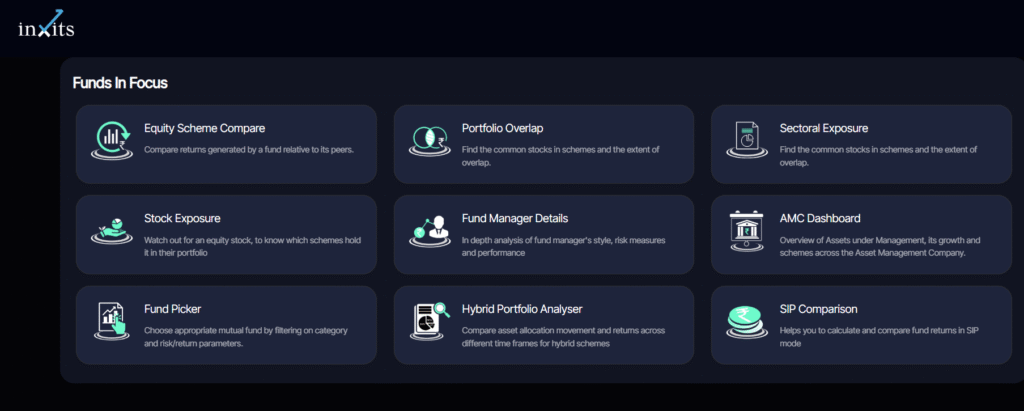
What makes inXits so special? Its intelligent technology and powerful tools act like your personal CFO. inXits analyzes your profile first, considering your investment psychology. Then, it gathers extensive data on stocks and mutual funds, offering detailed insights for informed decisions.

Key tools include:

  • Stock Exposure: See which mutual funds hold specific stocks like Infosys or Reliance.
  • Portfolio Overlap: Ensure your funds aren’t too similar, helping you diversify effectively.
  • Fund Manager Details: Learn about the individuals managing your funds.
  • Sectoral Exposure: Understand which funds are tied to specific sectors like banking or pharma.
  • AMC Dashboard: Get an overview of how asset management companies are investing.
  • Hybrid Portfolio Analyzer: Evaluate the performance of funds that blend stocks and safer options.

These tools simplify investing, helping you create long-term investment strategies and aiming for financial independence with clear, data-backed advice.

inXits: Your Partner at Every Stage

inXits is there for you no matter where you are in life.

Existing Investors: Easily transfer and manage your entire portfolio on the platform, making inXits a comprehensive solution.

Starting Out: Begin with a small SIP (e.g., ₹500) in an equity mutual fund, learning how to grow your money over time.

Growing Income: As your earnings increase, inXits suggests options that align with your new goals, like analyzing stock risks.

Planning for Big Dreams: When saving for a house or retirement, inXits helps adjust your financial plan with strategies that keep your money growing safely, even suggesting hybrid funds for balanced risk and growth.

Why Choose inXits for Life?

Choosing inXits means selecting a partner that stays with you forever. With India’s market offering significant growth opportunities (the Nifty 50 growing 8-15% annually over a decade), inXits is your ideal companion for wealth creation. It helps you maximize these opportunities, whether you’re starting with a SIP, exploring stocks, or selecting mutual funds that fit your aspirations. It’s more than just a website; it’s a personal CFO that uses smart tech and tools to guide your investment strategies for life. From your very first investment to retirement planning, inXits adapts to your needs, helping you build wealth with a financial plan that grows with you.

Ready to Take Charge of Your Money?

inXits is more than just a website, it’s your personal CFO for life! This blog showed how inXits helps Indian investors at every stage, using smart tools like Goal setting, Investor analysis, Stock Exposure, Portfolio Overlap and much more to make stocks, mutual funds, and SIPs simple. It grows with you, guiding you with investment strategies that fit your goals, whether you’re saving for a trip or planning for retirement. inXits your CFO turns your dreams into a financial plan you can trust, helping you build wealth with confidence. Ready to take charge of your money? Visit inXits today.

📱 Download our App