
Mutual Fund Overlap: Understanding Portfolio Duplication in Investments

Many investors build portfolios by investing in multiple mutual funds across categories. At first glance, this approach appears diversified because it spreads investments across different schemes. However, the underlying holdings of those funds may sometimes include the same stocks or securities.

This situation is known as mutual fund overlap, and it is more common than many investors realize. When investors select funds based only on category names or past popularity, they may unknowingly hold multiple funds that invest in similar companies.

As a result, the portfolio may appear diversified on the surface but still carry concentration in certain stocks or sectors. Therefore, understanding mutual fund overlap helps investors better interpret how diversification works in mutual fund portfolios.

This article explains what mutual fund overlap means, why it occurs, how investors evaluate it, and how it fits into a broader framework of portfolio analysis.

What Is Mutual Fund Overlap?

Mutual fund overlap refers to a situation where two or more mutual funds in an investor’s portfolio hold the same underlying securities.

For example, two different equity mutual funds may both hold shares of the same large companies.

A simplified illustration:

Mutual FundMajor Holdings
Fund ACompany A, Company B, Company C
Fund BCompany A, Company D, Company E

In this example, Company A appears in both funds, which creates overlap.

The securities quoted are for illustration only and are not recommendatory.

While some level of overlap may occur naturally, a high degree of overlap may reduce the intended diversification of the portfolio.

Understanding mutual fund overlap allows investors to look beyond the scheme name and focus on the actual composition of investments.

Why Mutual Fund Overlap Happens

Several factors contribute to the occurrence of mutual fund overlap in investor portfolios.

Similar Investment Strategies

Many funds follow similar investment philosophies. For instance:

  • Large-cap equity funds often invest in the same set of established companies
  • Index funds replicate benchmark indices
  • Sector funds focus on specific industries

Because of these strategies, different funds may hold overlapping securities.

Benchmark-Based Investing

Mutual funds often track or benchmark themselves against market indices such as Nifty or Sensex.

When multiple funds follow the same benchmark, their portfolios may include similar companies.

Popular Large-Cap Companies

Large and well-known companies often appear across multiple portfolios because of their market capitalization and liquidity.

Example illustration:

CompanyPresence in Multiple Funds
Company XFund A, Fund B, Fund C
Company YFund B, Fund D

The securities quoted are for illustration only and are not recommendatory.

Therefore, the presence of common holdings across funds contributes to mutual fund overlap.

Investors Holding Multiple Funds in the Same Category

Another reason for overlap is when investors allocate money to several funds within the same category.

Examples may include:

  • Two large-cap funds
  • Multiple flexi-cap funds
  • Several index funds tracking similar benchmarks

In such cases, overlapping portfolios can naturally occur.

How Mutual Fund Overlap Affects Portfolio Diversification

Diversification aims to spread investments across different assets to reduce concentration risk.

However, mutual fund overlap may affect diversification in the following ways.

Reduced True Diversification

Although an investor may hold several funds, overlapping holdings may lead to concentration in certain companies.

For example:

PortfolioActual Exposure
4 FundsLarge allocation to same 5 companies

The securities quoted are for illustration only and are not recommendatory.

This means the effective diversification may be lower than expected.

Similar Portfolio Movements

If multiple funds hold the same companies, their performance may move in similar directions when those stocks change in value.

As a result, the portfolio may respond similarly to market changes.

Duplication of Investment Strategy

When two funds follow similar strategies and hold similar securities, the investor may effectively hold duplicate exposure.

This does not necessarily mean the funds are unsuitable. However, it highlights the importance of understanding the underlying portfolio composition.

Overlap vs Diversification
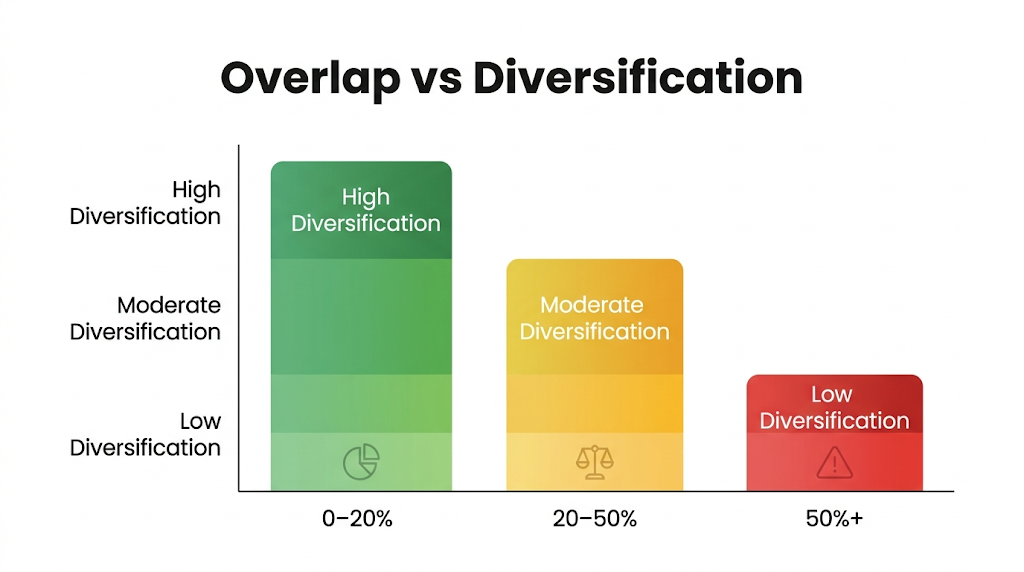
This chart shows how increasing mutual fund overlap can reduce overall portfolio diversification.

Measuring Mutual Fund Overlap

Investors and analysts often measure mutual fund overlap by comparing the holdings of two funds.

This process generally involves examining:

  • Top holdings
  • Sector allocation
  • Percentage weight of common securities

An example comparison may look like this:

CompanyFund A WeightFund B Weight
Company A8%7%
Company B6%5%
Company C4%4%

The securities quoted are for illustration only and are not recommendatory.

If a significant number of holdings match across two funds, the overlap level may be considered high.

Several analytical tools in the financial ecosystem allow investors to study portfolio holdings and identify overlaps.

Mutual Fund Overlap Percentage Formula

To quantify overlap between two mutual funds, investors often use an overlap percentage formula based on common holdings.

Overlap %=∑min(Weight in Fund A,Weight in Fund B)

This means comparing each common stock and taking the lower allocation between the two funds, then summing all such values.

Example (illustrative):

CompanyFund AFund BMin Weight
HDFC Bank8%7%7%
Reliance6%5%5%

Total overlap = 7% + 5% = 12%

The securities quoted are for illustration only and are not recommendatory.

Tools to Check Overlap

Investors can use various platforms to analyze mutual fund overlap, such as:

  • Fund house fact sheets (monthly portfolio disclosures)
  • Financial research platforms
  • Portfolio analysis tools offered by investment platforms
  • Aggregators that compare fund holdings side by side

For example, investors can use the inXits Portfolio Overlap tool to compare mutual funds and identify overlapping holdings in a structured manner.

Real India Example:

Consider an example from the Indian market:

Two large-cap funds may both hold companies such as Reliance Industries, HDFC Bank, and ICICI Bank. Even though the funds are different, their top holdings may significantly overlap because they invest in a similar universe of large-cap stocks.

The securities quoted are for illustration only and are not recommendatory.

Ideal Overlap Level

There is no fixed ideal overlap, but general guidelines include:

  • 0–20%: Low overlap (higher diversification)
  • 20–50%: Moderate overlap
  • Above 50%: High overlap (possible duplication of exposure)

The appropriate level depends on the investor’s strategy and portfolio structure.

When Overlap Is Dangerous

Overlap may become a concern in the following situations:

  • Holding multiple funds in the same category
  • High concentration in a few common stocks
  • Similar investment styles across funds
  • Market downturn affecting the same underlying holdings

In such cases, the portfolio may behave like a concentrated investment rather than a diversified one.

Situations Where Overlap May Naturally Occur

It is important to note that some degree of mutual fund overlap may occur naturally and does not always indicate a problem.

Large-Cap Fund Portfolios

Large-cap funds typically invest in a defined set of established companies.

Therefore, overlap across such funds may be expected.

Index Funds Tracking the Same Benchmark

Two index funds tracking the same index will naturally have nearly identical holdings.

Market Concentration

In markets where certain companies dominate index weight, multiple funds may include them as core holdings.

Therefore, understanding the structure of mutual funds helps investors interpret overlap appropriately.

Evaluating Portfolio Structure Beyond Overlap

While analyzing mutual fund overlap, investors often examine broader portfolio characteristics as well.

These may include:

Asset Allocation

Asset allocation refers to how investments are distributed across asset classes such as:

  • Equity
  • Debt
  • Gold
  • Cash equivalents

Sector Exposure

Some portfolios may show concentration in specific sectors.

Example illustration:

SectorPortfolio Exposure
Banking30%
Technology20%
Consumer Goods15%

This structure may influence portfolio behavior during sector-specific market changes.

Investment Style

Funds may follow different styles such as:

  • Growth investing
  • Value investing
  • Blend strategies

Understanding style differences helps interpret portfolio composition.

Example Scenario of Mutual Fund Overlap

Consider a hypothetical portfolio:

FundCategory
Fund ALarge Cap
Fund BFlexi Cap
Fund CIndex Fund

After examining holdings, an investor finds that the same five companies appear across all three funds.

The securities quoted are for illustration only and are not recommendatory.

In this scenario, the investor may observe that multiple funds share similar exposures.

This example demonstrates how mutual fund overlap can occur even when funds belong to different categories.

How Structured Portfolio Reviews Help Investors

Portfolio evaluation involves understanding how investments interact with each other rather than analyzing each fund individually.

Many investors review portfolios periodically to understand:

  • Asset allocation balance
  • Sector exposure
  • Portfolio concentration
  • Overlapping holdings
  • Long-term financial goals

Approaching financial decisions through a structured framework—similar to how a personal CFO analyzes financial information—can help organize these factors more clearly.

Platforms such as inXits combine research frameworks and technology to help investors understand portfolio structures, diversification patterns, and financial planning considerations.

Connect with inXits for a 24×7 consultation focused on financial planning and portfolio review processes.

Conclusion

Mutual funds are widely used by investors to access diversified portfolios managed by professional fund managers. However, owning multiple funds does not automatically guarantee diversification.

Understanding mutual fund overlap helps investors examine the actual holdings within their portfolio and evaluate how different funds interact with each other.

Overlap can occur due to similar investment strategies, benchmark tracking, or concentration in large-cap companies. While some overlap may occur naturally, analyzing portfolio structure provides greater clarity about diversification and exposure.

Therefore, continuous learning, periodic portfolio reviews, and structured financial analysis play an important role in understanding how mutual fund investments fit within long-term financial planning.

Connect with inXits for a 24×7 consultation focused on financial planning and portfolio review processes.

📘 Disclaimer
Investment in securities market are subject to market risks. Read all the related documents carefully before investing.
Registration granted by SEBI, membership of BSE and certification from NISM in no way guarantee performance of the intermediary or provide any assurance of returns to investors.
The securities quoted are for illustration only and are not recommendatory.
Best SIP Strategy for Business Owners with Irregular Income

Most SIP advice assumes one thing. A fixed monthly income. But business owners, freelancers, and entrepreneurs know that reality looks very different.

Some months feel strong. Others are unpredictable. Income can fluctuate based on clients, cycles, or market conditions.

And because of this, many business owners delay investing altogether. The problem is not lack of intent. It is a lack of a structure that fits their reality.

This is where a different SIP approach becomes necessary — one built around your income reality, not a fixed-salary template.

What this covers

  • Why traditional SIP advice doesn’t fit business owners
  • A practical SIP structure for irregular income
  • How to stay consistent without pressure
  • Common mistakes to avoid

Why Fixed SIP Doesn’t Always Work for Business Owners

A fixed SIP assumes:

  • Stable income
  • Predictable cash flow
  • Consistent monthly surplus

For business owners, this is rarely the case.

What usually happens:

  • Good month (e.g., ₹1.5 lakh income) → comfortable investing, surplus available
  • Slow month (e.g., ₹40,000 income) → fixed SIP of ₹15,000 feels like a burden

Result:

  • SIP gets paused, skipped, or stopped entirely — breaking the compounding chain and undoing months of disciplined investing.

To understand how SIP is designed, it helps to revisit how SIP works in structured scenarios.

The Core Problem: Consistency vs Flexibility

Most investors think consistency and flexibility are opposites.

Either you commit to a fixed amount and risk missing payments during slow months — or you invest whenever you can and end up with no real pattern at all.

For business owners, the right answer is neither extreme. The goal is a structure that is disciplined by design but flexible by default

The Right Approach: Flexible Core + Opportunistic Investing

Instead of one rigid SIP, a better structure looks like this:

1. Base SIP (Minimum commitment)

  • Choose an amount you can comfortably pay even in your worst income month
  • As a rule of thumb: 5–10% of your lowest expected monthly income
  • Example: If your worst month brings in ₹50,000, a base SIP of ₹3,000–5,000 is realistic and sustainable.

2. Top-Up Investments (During surplus)

  • Invest extra when income is strong
  • No pressure during slow periods

Why this works:

  • Maintains continuity
  • Uses good months effectively
  • Reduces stress

This approach is closely aligned with how flexible SIP is designed.

Real-Life Scenario: Business Owner SIP Strategy

Let’s take Karan, 34, running a digital agency in Ahmedabad.

Income pattern:

  • Low month → ₹50,000
  • Strong month → ₹1.5 lakh

His SIP structure:

  • Base SIP → ₹5,000/month
  • Additional investment → ₹10,000–₹20,000 during strong months

Outcome:

  • Never stops investing
  • Uses high-income periods effectively
  • Maintains discipline without pressure

How Much Should You Invest?

This is where most business owners feel stuck.

Instead of fixed numbers, think in ranges.

Practical framework:

Income TypeSIP Approach
Low income monthMinimum SIP
Average monthStandard SIP
High income monthTop-up investment

Should You Use Multiple SIPs?

For business owners, one SIP may not be enough.

Better approach:

  • Growth SIP (Equity fund) → Core long-term wealth building; invest the bulk of your surplus here; 7–10 year horizon
  • Stability SIP (Hybrid or balanced fund) → Medium-term goals (3–5 years); less volatile than pure equity
  • Liquidity allocation (Liquid or overnight fund) → Not a SIP but a parallel investment; park surplus here for emergency access without disrupting your SIP

This is where the multi SIP strategy becomes useful.

Where Step-Up SIP Fits (And Where It Doesn’t)

Step-up SIP works well when income grows predictably.

But business income is not always linear.

When it works:

  • Business income steadily increasing
  • Predictable growth

When to be cautious:

  • If your income swings by more than 50% month to month, a fixed annual step-up may not be appropriate.
  • Instead, use manual top-ups during strong months rather than a pre-committed annual increase — this preserves flexibility without abandoning growth.

To understand its structure better, you can explore step-up SIP.

Common Mistakes Business Owners Make

1. Waiting for “stable income” to start

👉 Result: Every year of delay costs you compounding returns.

A ₹5,000/month SIP started at 30 instead of 35 creates roughly ₹8–10 lakh more corpus by age 50 at 12% CAGR — even with identical monthly amounts.

2. Investing aggressively during good months only, with nothing during slow months

👉 Result: Lumpy, inconsistent investment that misses the key benefit of SIP — rupee-cost averaging.

3. Stopping SIP during slow months entirely

👉 Result: A broken compounding chain.

Stopping a ₹10,000/month SIP for just 3 months a year over 10 years could reduce your corpus by ₹3–5 lakh compared to uninterrupted investing.

4. Not separating business and personal finances

👉 Result: Unclear investment capacity and the constant temptation to “temporarily” pause your SIP for business expenses.

A Better Way to Think About Investing

Instead of asking:

“How much should I invest every month?”

Ask:

“How can I invest consistently despite income variability?”

That shift makes the strategy more realistic.

A Simple Checklist for Business Owners

  • Do you have a minimum SIP you can always maintain?
  • Do you invest more during high-income months?
  • Is your SIP flexible enough to adjust?
  • Are your investments linked to goals?

If yes, your structure is working.

How inXits Helps Business Owners Structure SIP

Business income is different. Investment strategy should reflect that.

At inXits, advisors help:

  • Build flexible SIP structures
  • Align investments with irregular cash flow
  • Balance liquidity and long-term growth

This ensures investing supports your business, not conflicts with it.

Conclusion

For business owners, the challenge is not investing. It is investing consistently in an inconsistent income environment.

A rigid SIP structure may not always work. But a flexible, structured approach can. The goal is not to follow a perfect monthly plan. It is to create a system that works even when income fluctuates.

If your current SIP feels difficult to maintain or too rigid, it may not be about discipline. It may be about structure.

A practical conversation with a mutual fund advisor can help design an approach that fits your income pattern, rather than forcing you into a fixed template.

Disclaimer

Investments in securities markets are subject to market risks. Read all related documents carefully before investing.

inXits is a SEBI-registered investment adviser (Registration No. INA000020369). This article is for educational purposes only and does not constitute personalised investment advice.

Registration granted by SEBI, membership of BSE, and certification from NISM in no way guarantee performance of the intermediary or provide any assurance of returns to investors.

Step-Up SIP vs Regular SIP: Which Builds More Wealth?

Most investors start with a simple question. “Should I just continue my SIP as it is, or should I increase it over time?” 

This is exactly the step-up SIP vs regular SIP debate — and the answer depends less on which is better in theory, and more on where you are in your financial journey.

At first, a regular SIP feels enough. You pick an amount, automate it, and move on. But as income grows, another thought appears.

“Should my investments grow too?”

This is where the comparison between step-up SIP and regular SIP becomes relevant. Not because one is universally better, but because each fits a different stage of an investor’s journey.

What you’ll understand here

  • The difference between regular and step-up SIP
  • When each approach works better
  • How income growth changes your SIP strategy
  • A simple way to decide what suits you

What is a Regular SIP?

A regular SIP is a fixed monthly investment into a mutual fund.

  • Same amount every month
  • No automatic increase
  • Simple and predictable

If you want a deeper breakdown, you can explore how regular SIP works in the broader SIP structure.

What is a Step-Up SIP?

A step-up SIP increases your investment amount at regular intervals, usually every year.

  • Amount increases automatically
  • Can be fixed or percentage-based
  • Aligns with income growth

To understand this in detail, you can read about step-up SIP and how it scales investments over time.

Core Difference: Fixed vs Growing Investment

At the core, the difference is simple.

FeatureRegular SIPStep-Up SIP
Investment amountFixedIncreases over time
FlexibilityLowModerate
ComplexitySimpleSlightly higher
Alignment with incomeLimitedStrong

Real-Life Example: Why This Difference Matters

Let’s take two investors.

Rahul (Regular SIP)

  • Starts SIP: ₹5,000/month
  • Continues same for 10 years

Aman (Step-Up SIP)

  • Starts SIP: ₹5,000/month
  • Increases by 10% every year

After a few years:

YearRahul SIPAman SIP
Year 1₹5,000₹5,000
Year 5₹5,000~₹7,300
Year 10₹5,000~₹11,800

👉 Same start, very different trajectory

This difference becomes more meaningful over longer periods.

When Regular SIP Works Better

Regular SIP is not outdated. It works well in specific situations.

It suits:

  • Beginners starting their investment journey
  • Investors with stable but limited income
  • Those who prefer simplicity
  • People unsure about long-term commitment

If you are just starting, understanding what is SIP gives a strong foundation.

When Step-Up SIP Makes More Sense

Step-up SIP becomes relevant as your financial situation evolves.

It suits:

  • Salaried individuals with annual increments
  • Investors planning long-term goals
  • People who want to optimise wealth creation
  • Investors already comfortable with SIP

For long-term planning, it also helps to connect SIP with goals. Exploring goal-based SIP planning can make this clearer.

Assumption vs Reality

AssumptionReality
Regular SIP is enough foreverIt may underutilise income growth
Step-up SIP is complicatedIt is a simple structured increase
Higher SIP increase is riskyRisk depends on fund, not SIP type

Impact on Long-Term Investing

This is where the difference becomes more visible.

Regular SIP

A regular SIP offers stability and predictability. You invest the same amount every month, which makes budgeting easier and helps maintain financial discipline.

It works especially well for:

  • Beginners starting their investment journey
  • Investors with fixed monthly income
  • People who prefer simplicity and consistency

Since the investment amount stays unchanged, it is easier to plan around monthly expenses and maintain long-term commitment.

However, over time, if your income increases but your SIP remains the same, your investment may not fully reflect your growing financial capacity.

Step-Up SIP

A step-up SIP allows your investments to grow alongside your income.

As salaries increase and financial capacity improves, your monthly investment also rises automatically—usually by a fixed percentage every year.

This creates a stronger long-term impact because SIP wealth creation depends not only on time, but also on contribution size.

Even small annual increases can create a significantly larger corpus over 10–20 years compared to keeping the same SIP amount fixed forever.

It works especially well for:

  • Salaried professionals with annual increments
  • Investors planning retirement or children’s education
  • People focused on long-term wealth creation

This is why step-up SIP often becomes more relevant for investors with long-term financial goals.

To understand how SIP behaves over time, revisiting how SIP works gives useful perspective.

How to Choose Between Step-Up SIP and Regular SIP

Instead of asking “which is better,” ask the following practical questions:

1. Is Your Income Growing Regularly?

If your salary increases every year, keeping your SIP fixed may slowly reduce its effectiveness.

Yes → Consider Step-Up SIP
No → Regular SIP may work better

Your investment strategy should reflect your earning capacity, not just your starting point.

2. Can You Increase Investments Without Financial Stress?

A step-up SIP should feel manageable, not forced.

If increasing your SIP by 5–10% annually feels realistic, step-up SIP can strengthen long-term outcomes.

Yes → Step-Up SIP fits well
No → Start with Regular SIP

Consistency matters more than aggressive investing.

3. Are Your Goals Long-Term?

For goals like retirement, wealth creation, or children’s education, step-up SIP often adds more value because time amplifies contribution growth.

For shorter-term goals, a regular SIP may be enough.

Yes → Step-Up SIP adds value
No → Regular SIP may be sufficient

4. Do You Prefer Simplicity or Optimisation?

Some investors value simplicity and peace of mind. Others prefer optimising returns through structured planning.

Regular SIP offers simplicity.
Step-up SIP offers growth efficiency.

Choose the structure you are more likely to stay committed to.

Can You Combine Both?

Yes, and many investors do.

Example structure:

  • Regular SIP for short-term goals
  • Step-up SIP for long-term goals

This creates a balance between stability and growth.

To explore different structures, reviewing types of SIP helps compare options.

Common Mistake to Avoid

Many investors make this mistake:

  • Start SIP → never increase it

Over time, this reduces the effectiveness of investing.

If you want to understand behavioural mistakes better, you can explore SIP mistakes that reduce returns.

Have a question about whether your SIP should stay fixed or grow with your income? Talk to a mutual fund advisor — a conversation with a qualified advisor, no forms, no wait.

How inXits Helps You Decide the Right SIP Strategy

Choosing between regular and step-up SIP is not just about preference. It depends on income, goals, and long-term planning.

At inXits, advisors help investors:

  • Align SIP with income growth
  • Structure investments across goals
  • Avoid under-investing over time

This ensures SIP evolves with your financial journey.

Conclusion

Regular SIP and step-up SIP are not competing options. They are different stages of the same journey. Regular SIP helps you start. Step-up SIP helps you grow. The real question is not which one is better in general, but which one fits your current situation.

As your income and goals evolve, your SIP strategy should evolve too.

If your SIP has remained unchanged despite income growth, it may be worth reviewing whether it still reflects your financial capacity. If you want to structure your SIP in a way that grows with your life, build a smarter SIP strategy aligned with your goals.

SIP Mistakes That Reduce Returns (And How to Avoid Them)

Most investors don’t fail because they picked the wrong fund. The real culprit is usually a set of common SIP mistakes that seemed harmless at the time but quietly eroded returns over years.

Skipping a SIP during a market fall. Starting with enthusiasm but not increasing it. Investing without a clear purpose. None of these feel like big mistakes individually.

But over time, they quietly reduce returns.

The tricky part is that these mistakes are not obvious. They don’t show immediate consequences. They show up years later.

Understanding these patterns early can help you avoid losing potential growth without even realising it.

Before we get into it

  • SIP mistakes are usually behavioural, not technical
  • Small changes can improve long-term outcomes
  • Consistency matters more than short-term decisions
  • Structure matters more than starting amount

Mistake 1: Stopping SIP During Market Falls

This is one of the most common reactions.

What investors think:

  • “Market is falling, I should pause SIP”

What actually happens:

  • You stop buying at lower prices
  • You miss potential recovery participation

Why this matters:

Market corrections are a normal part of investing, not a signal to stop. In fact, falling markets often create opportunities because your SIP buys more units at lower prices.

This is the core benefit of rupee cost averaging. When markets recover, those accumulated units can significantly improve long-term returns.

Stopping SIP during volatility often means missing the exact phase where SIP works best.

To understand why continuing matters, it helps to see how SIP works during volatile phases.

Mistake 2: Starting SIP but Never Increasing It

Many investors start SIP and then forget to adjust it.

The problem:

  • Income increases
  • SIP remains constant

Result:

  • Investment does not match earning capacity

Better approach:

  • Increase SIP annually
  • Even small increments help

A ₹5,000 SIP may feel sufficient today, but after a few years of salary growth and inflation, it may no longer support your financial goals.

This is where a step-up SIP becomes useful. Increasing your SIP by even 10% annually can create a major difference in long-term wealth creation without putting sudden pressure on your monthly budget.

Small increases done consistently often matter more than large one-time investments.

This is where step-up SIP becomes relevant for long-term planning.

Mistake 3: Investing Without a Clear Goal

A SIP without purpose often loses direction.

What happens:

  • Motivation drops
  • SIPs gets discontinued
  • Decisions become reactive

What works better:

  • Link SIP to specific goals

When investors don’t know what the SIP is meant for, it becomes easy to pause, stop, or withdraw early. A goal creates emotional commitment and makes consistency easier.

Whether it is retirement, buying a home, children’s education, or building emergency security, purpose improves discipline.

Goal-based investing also helps decide the right amount, time horizon, and fund selection more clearly.

If you want to structure this properly, exploring goal-based SIP planning can bring clarity.

Mistake 4: Relying on a Single SIP

One SIP feels simple. But it creates concentration.

Risks:

  • Dependence on one fund
  • No diversification
  • Limited flexibility

Better structure:

  • Use multiple SIPs across categories

Relying on a single SIP may expose your investments to unnecessary concentration risk. Different goals often require different investment approaches.

For example, short-term stability and long-term growth may not fit into one single fund strategy.

A well-structured multi-SIP approach allows diversification across categories like large-cap, hybrid, or debt-oriented funds while keeping your portfolio balanced and goal-focused.

To understand how diversification works, you can explore multi SIP strategy.

Mistake 5: Choosing Wrong SIP Amount

This mistake shows up in two ways:

Case 1: Too high

  • Hard to maintain
  • Leads to stopping SIP

Case 2: Too low

  • Easy to maintain
  • But insufficient growth

The balance:

  • Start manageable
  • Increase gradually

If you are unsure where you stand, reviewing how much SIP to invest based on salary helps bring clarity.

Mistake 6: Ignoring Income Pattern

Not all investors have stable income.

Problem:

  • Fixed SIP with unstable income → inconsistency

Better option:

  • Use flexible structure

This is where flexible SIP may be more suitable.

Mistake 7: Expecting Quick Results from SIP

SIP is often misunderstood as a short-term tool.

Reality:

  • SIP works better over longer durations
  • Short-term fluctuations are normal

Impact of impatience:

  • Early exit
  • Unrealistic expectations

Mistake 8: Overcomplicating SIP Portfolio

Some investors go in the opposite direction.

What happens:

  • Too many SIPs
  • Overlapping funds
  • Difficult to track

Ideal approach:

  • Keep it simple but structured

If you are comparing different approaches, reviewing types of SIP helps avoid unnecessary complexity.

Mistake 9: Not Reviewing SIP Periodically

Many investors “set and forget” their SIP.

Why this is a problem:

  • Goals change
  • Income changes
  • Market conditions change

What helps:

  • Annual review
  • Adjust SIP accordingly

A Quick Summary of Mistakes

MistakeImpact
Stopping SIP during fallMissed opportunity
Not increasing SIPLower long-term growth
No goal clarityWeak discipline
Single SIPLack of diversification
Wrong SIP amountInconsistency
Ignoring income patternSIP disruption
Expecting quick returnsEarly exit
Too many SIPsConfusion
No reviewMisalignment

A Different Perspective on SIP Success

Most investors look for the “best fund.”

But SIP success usually depends on:

  • Staying consistent
  • Increasing gradually
  • Aligning with goals
  • Avoiding emotional decisions

Returns improve when behaviour improves.

A Simple Self-Diagnosis

Ask yourself honestly:

  • Have I ever stopped SIP due to market fall?
  • Have I increased SIP in last 2 years?
  • Do I know why I am investing?
  • Is my SIP structure clear or random?

If multiple answers feel uncomfortable, it is a sign your SIP needs restructuring.

Have a question about whether your SIP setup is reducing your potential returns without you realising it? Talk to a mutual fund advisor — a conversation with a qualified advisor, no forms, no wait.

How inXits Helps You Avoid These Mistakes

Avoiding mistakes is often more important than chasing returns.

At inXits, advisors help investors:

  • Build structured SIP strategies
  • Align investments with goals
  • Avoid portfolio overlap
  • Review and adjust periodically

This helps turn SIP into a disciplined system rather than a reactive habit.

Conclusion

SIP mistakes rarely feel like mistakes in the moment. They feel like reasonable decisions. But over time, they can quietly reduce the effectiveness of your investments. The good part is that most of these mistakes are avoidable.

Small corrections, made early, can improve long-term outcomes without requiring complex strategies.

If your SIP feels unstructured or inconsistent, it may not be about starting again. It may be about refining what already exists.

A thoughtful review can reveal gaps you might not notice on your own. If you want to identify and fix these gaps in your current SIP setup, analyse and improve your SIP strategy with a more structured approach.

Disclaimer

Investments in securities markets are subject to market risks. Read all related documents carefully before investing.

inXits is a SEBI-registered investment adviser (Registration No. INA000020369). This article is for educational purposes only and does not constitute personalised investment advice.

Registration granted by SEBI, membership of BSE, and certification from NISM in no way guarantee performance of the intermediary or provide any assurance of returns to investors.

SIP Strategy for Freelancers: How to Invest with Irregular Income

Freelancing gives freedom — but it also brings unpredictability.

If you’re looking for an SIP strategy for freelancers, the challenge is clear: some months are strong, some are average, and some feel uncertain.

Most investment advice assumes a fixed monthly income, which simply doesn’t apply to freelance work.

This is where your SIP strategy needs to be adapted, not abandoned.

What this will help you with

  • How to approach SIP with irregular income
  • A practical structure for freelancers
  • Mistakes to avoid
  • How to balance flexibility with discipline

Why Standard SIP Advice Doesn’t Work for Freelancers with Irregular Income

Most SIP advice assumes:

  • Fixed salary
  • Predictable expenses
  • Stable monthly surplus

Freelancers don’t always have that.

Common challenges:

  • Income fluctuation
  • Delayed payments
  • Irregular cash flow
  • Difficulty committing to fixed SIP

Because of this, blindly following standard SIP advice can lead to:

  • Missed SIPs
  • Stopping investments
  • Financial stress

The Right Way to Think About SIP as a Freelancer

Instead of asking:

“How much should I invest every month?”

Ask:

“How can I invest consistently across different income situations?”

This shift matters.

Strategy 1: Set a Base SIP Amount That Works on Low-Income Months

Start with a minimum commitment.

Example:

  • Comfortable SIP → ₹3,000/month
  • Not aggressive → sustainable

👉 The goal is consistency, not pressure

If you are unsure where to start, understanding how much SIP to invest based on salary can help you estimate a safe range.

Strategy 2: Use a Flexible SIP to Match Your Irregular Income

Freelancers need adaptability.

How it works:

  • Base SIP → fixed minimum
  • Surplus months → increase SIP
  • Low-income months → reduce amount

This is where flexible SIP becomes very useful.

Strategy 3: Invest in Income Cycles, Not Fixed Monthly Amounts

Instead of thinking monthly:

Think in income cycles:

  • High-income period → invest more
  • Low-income period → maintain base SIP

This reduces pressure and improves sustainability.

Strategy 4: Separate Personal and Business Cash Flow

One of the biggest mistakes freelancers make is mixing money.

Better structure:

  • Income → business account
  • Fixed transfer → personal account
  • SIP → from personal account

This creates stability even when income fluctuates.

Strategy 5: Increase SIP When Income Stabilises

Freelancers often experience growth phases.

When to increase SIP:

  • Consistent higher income
  • Stable client base
  • Reduced financial uncertainty

Instead of manual increases, some prefer structured scaling.

That is where step-up SIP can help when income becomes predictable.

Real-Life Scenario: Freelancer SIP in Action

Meet Karan, 29, Freelance Designer Based in Ahmedabad

  • Monthly income: ₹40,000 to ₹1,00,000
  • Base SIP: ₹4,000

His strategy:

  • Low-income month → ₹4,000
  • Medium month → ₹6,000
  • High-income month → ₹10,000

Result:

  • Consistent investing
  • No financial pressure
  • Better long-term accumulation

To understand long-term impact, it helps to revisit how SIP works over time.

Should Freelancers Use Multiple SIPs?

Yes, but with structure.

Example:

  • Growth SIP → long-term wealth
  • Stability SIP → buffer

This is part of a structured approach.

You can explore multi SIP strategy to understand how to diversify effectively.

Common Mistakes Freelancers Should Avoid

Avoid:

  • Setting high SIP during good months
  • Stopping SIP during bad months
  • Not separating cash flow
  • Ignoring long-term planning

A Simple Freelancer SIP Framework

Instead of overthinking, follow this:

  1. Set base SIP
  2. Add flexible top-ups
  3. Increase gradually
  4. Review periodically

A Quick Self-Check

  • Can I maintain my SIP in low-income months?
  • Am I increasing SIP during good months?
  • Do I have a structured approach or random investing?

If not, your SIP strategy may need adjustment.

How inXits Helps Freelancers Structure SIP

Freelancers don’t need a different investment product. They need a different structure.

At inXits, advisors help freelancers:

  • Design SIP based on income variability
  • Balance flexibility with discipline
  • Align investments with long-term goals

This helps turn irregular income into a structured investment plan.

Conclusion

Freelancing does not make SIP difficult. It just makes it different. The goal is not to follow rigid rules. It is to build a system that works with your income pattern.

A flexible, structured approach allows you to stay consistent without financial pressure. Over time, consistency matters more than perfection.

If your current SIP feels stressful or inconsistent, it may not be the investment that needs changing. It may be the structure. A thoughtful conversation with a mutual fund advisor can help you design a SIP strategy that adapts to your income rather than fighting against it.

Disclaimer

Investments in securities markets are subject to market risks. Read all related documents carefully before investing.

inXits is a SEBI-registered investment adviser (Registration No. INA000020369). This article is for educational purposes only and does not constitute personalised investment advice.

Registration granted by SEBI, membership of BSE, and certification from NISM in no way guarantee performance of the intermediary or provide any assurance of returns to investors.

How to Increase SIP Returns Over Time (Without Guesswork)

If you want to increase SIP returns over time, the answer is not in timing the market—it is in how you structure and manage your investments.

Most investors don’t worry about returns in the beginning. The focus is on starting, picking a fund, and staying consistent. But after a year or two, a different question starts to appear:

“Can I do better with my SIP?”

That question is valid. Not because SIP is flawed, but because how you use SIP matters as much as the fact that you use it.

Returns are not just about market performance. They are shaped by behaviour, structure, and decisions made over time.

What this covers

  • Why SIP returns vary even with similar investments
  • Practical ways to improve long-term outcomes
  • Common mistakes that quietly reduce returns
  • How to structure SIP for better efficiency

Why SIP Returns Differ for Different Investors

Two investors can invest in similar funds and still see different outcomes.

The difference usually comes from:

  • Investment duration
  • Consistency during market volatility
  • Amount invested over time
  • Strategy used (fixed vs growing SIP)

To understand the foundation, it helps to revisit how SIP works across market cycles.

Strategy 1: Increase Your SIP Over Time

This is one of the most overlooked ways to improve returns.

Many investors start SIP but never increase it.

Why this matters:

  • Income increases over time
  • Expenses rise
  • But investments remain constant

Better approach:

  • Increase SIP annually
  • Even 5–10% increase can make a difference

This is where using a step-up SIP strategy can make a measurable difference to your long-term corpus. 

Strategy 2: Stay Invested During Market Downturns

This feels counterintuitive, but it is critical.

What most investors do:

  • Stop SIP when markets fall
  • Wait for stability

What actually helps:

  • Continue investing
  • Buy more units at lower prices

Why it matters:

  • Market corrections are part of investing
  • Long-term returns depend on participation

Understanding this behaviour is easier when you see how SIP works in volatile markets.

Strategy 3: Align SIP with Clear Goals

SIPs without purpose often get discontinued.

SIPs linked to goals tend to continue.

Example:

  • Retirement → long-term SIP
  • Child education → structured SIP
  • Short-term goal → conservative SIP

If you want to structure this properly, exploring goal-based SIP planning helps connect investments with real outcomes.

Strategy 4: Use Multiple SIPs Instead of One

Many investors rely on a single SIP.

But that can limit diversification.

A better structure:

  • Large-cap SIP → stability
  • Mid-cap SIP → growth
  • Hybrid or debt SIP → balance

This is where a multi SIP approach becomes relevant. You can explore multi SIP strategy to understand diversification better.

Strategy 5: Choose SIP Type Based on Income Pattern

Not all SIPs should be fixed.

Different approaches:

  • Stable salary → Regular SIP
  • Growing income → Step-up SIP
  • Irregular income → Flexible SIP.

Understanding the different types of SIP in mutual funds—fixed, step-up, flexible, and perpetual—helps you pick the right structure for your income pattern. 

Strategy 6: Avoid Common SIP Mistakes

Sometimes, improving returns is about avoiding mistakes.

Common issues:

  • Stopping SIP during market fall
  • Investing without goal clarity
  • Not increasing SIP over time
  • Choosing overlapping funds

Small corrections → big long-term impact

A Simple Comparison: Passive vs Active SIP Behaviour

BehaviourPassive InvestorStructured Investor
SIP amountFixed foreverIncreased over time
Market reactionStops during fallContinues investing
PlanningRandomGoal-based
DiversificationSingle fundMultiple SIPs

👉 Over time, behaviour creates the difference.

A Different Way to Think About Returns

Instead of asking:

“How can I get higher returns?”

Try asking:

“How can I improve my investing behaviour?”

Because SIP returns are not just about the market. They are about:

  • Consistency
  • Allocation
  • Time in market
  • Discipline

A Quick Self-Check

Before trying to improve returns, ask:

  • Have I increased my SIP in the last 2 years?
  • Am I investing consistently during market dips?
  • Are my SIPs linked to clear goals?
  • Am I diversified or dependent on one fund?

If multiple answers are “no,” there is room to improve.

How inXits Helps Improve SIP Strategy

Improving SIP returns is not about chasing performance. It is about structuring investments correctly.

At inXits, advisors help investors:

  • Align SIP with income growth
  • Avoid portfolio overlap
  • Build goal-based allocation
  • Review strategy periodically

This turns SIP from a simple habit into a structured financial system.

Conclusion

SIP returns do not improve because of one big decision.

They improve because of multiple small decisions made consistently over time.

Increasing SIP gradually, staying invested during volatility, aligning with goals, and structuring investments properly can make a meaningful difference.

Most importantly, returns improve when investing becomes intentional rather than automatic.

If your SIP has been running on autopilot for a while, it may be worth reviewing how it is structured today.

A thoughtful adjustment now can influence long-term outcomes more than trying to predict markets. If you want to refine how your SIP is working for you, review and optimise your SIP strategy with a clearer structure.

Disclaimer

Investments in securities markets are subject to market risks. Read all related documents carefully before investing.

inXits is a SEBI-registered investment adviser (Registration No. INA000020369). This article is for educational purposes only and does not constitute personalised investment advice.

How Much Should You Invest in SIP Based on Salary?

Deciding how much to invest in SIP based on your salary is one of the first and most important financial decisions you will make as an investor.

One of the most common questions investors ask is surprisingly simple: “How much should I invest in SIP?” Not when to start. Not which fund to choose. Just how much.

Some people start too small and stay there for years. Others try to invest aggressively and struggle to maintain consistency. Both situations come from the same issue — lack of a clear framework.

A SIP works best when it fits your income, your lifestyle, and your goals. Not when it follows a random number.

Before You Go Deeper

  • SIP amount should be linked to income, not guesswork
  • Starting small is fine, but staying small may not be ideal
  • Consistency matters more than perfection
  • SIP should evolve as your salary grows

Is There an Ideal SIP Percentage of Salary?

There is no single “correct” number, but there are practical ranges.

Most financial planning frameworks suggest:

General guideline

  • 20% to 30% of income → Total savings
  • 10% to 20% of income → SIP allocation

But this depends on your situation.

Simple rule to think about:

  • Lower income → Start smaller, build habit
  • Stable income → Increase SIP gradually
  • Higher income → Optimise allocation across goals

If you are new to the concept itself, understanding what is SIP helps before deciding the amount.

According to data and investor awareness initiatives by SEBI and AMFI, disciplined investing through SIPs is one of the most widely recommended approaches for retail investors in India. SIP contributions have consistently grown year-on-year, reflecting increasing investor trust in systematic investing. 

Salary-Based SIP Allocation (Practical Table)

Here is a simple reference to make things clearer:

Monthly SalarySuggested SIP RangeApproach
₹20,000 – ₹40,000₹1,000 – ₹4,000Focus on consistency
₹40,000 – ₹80,000₹4,000 – ₹12,000Balance savings + lifestyle
₹80,000 – ₹1.5L₹10,000 – ₹25,000Goal-based allocation
₹1.5L+₹25,000+Structured portfolio approach

👉 These are not fixed rules, but starting points.

Why Most Investors Get SIP Amount Wrong

The mistake is not about math. It is about behaviour.

Common patterns:

  • Starting too high → stopping after few months
  • Starting too low → not scaling later
  • Copying others → ignoring personal situation

The better approach:

  • Start with a comfortable amount
  • Build consistency
  • Increase gradually

This is where understanding step-up SIP becomes useful, especially as income grows.

Real-Life Scenario: Salary vs SIP Growth

Let’s take a practical example.

Meet Ankit, 27, working in Ahmedabad

  • Salary: ₹50,000/month
  • Starting SIP: ₹5,000 (10%)

What happens over time?

YearSalarySIP AmountStrategyEstimated Corpus
Year 1₹50,000₹5,000Start₹60,000
Year 3₹65,000₹7,000Step-up₹2.8–3.2 lakh
Year 5₹85,000₹10,000Growth₹6.5–7.5 lakh
Year 10₹1.2L+₹15,000+Structured₹20–25 lakh

Assumes 10–12% annual returns; actual returns may vary

👉 Instead of staying fixed, SIP grows with income

This approach feels more natural and sustainable.

To understand how this builds over time, you can explore how SIP works in long-term investing.

Fixed SIP vs Growing SIP (Important Comparison)

FactorFixed SIPGrowing SIP
ContributionSameIncreases
Wealth potentialModerateHigher
FlexibilityLowHigh
SuitabilityBeginnersLong-term planners

A fixed SIP is a starting point. A growing SIP is a strategy.

How to Decide Your SIP Amount (Simple Framework)

Instead of guessing, use this structure.

Step 1: Track your expenses

Understand how much you actually spend monthly.

Step 2: Define savings capacity

Subtract expenses from income.

Step 3: Allocate percentage

  • Start with 10%
  • Move towards 15–20% gradually

Step 4: Link to goals

Your SIP should not be random.

If you want structured planning, understanding goal-based SIP planning helps connect investments with real-life milestones.

When Should You Increase Your SIP?

This is where many investors fail.

Ideal triggers:

  • Salary increment
  • Bonus income
  • Reduced expenses
  • Financial milestone achieved

Instead of manually increasing every time, some investors prefer structured approaches.

That is where types of SIP become relevant, especially step-up and flexible options.

What If Your Income Is Not Fixed?

Not everyone has a predictable salary.

In such cases:

  • Avoid aggressive fixed SIP
  • Keep base SIP manageable
  • Increase during surplus months

This is where flexible SIP can be more suitable than a fixed structure.

A Simple Reality Check

Before deciding your SIP amount, ask:

  • Can I continue this for 3–5 years?
  • Will this affect my essential expenses?
  • Can I increase this amount later?

If the answer is yes, you are on the right track.

How inXits Helps You Decide SIP Amount

Knowing the percentage is helpful. Applying it correctly is where things get complex.

At inXits, advisors help investors:

  • Align SIP with income and expenses
  • Structure investments across goals
  • Adjust SIP as financial situation evolves

This helps avoid both under-investing and over-committing.

Conclusion

There is no perfect SIP amount. There is only a suitable SIP amount for your situation.

The goal is not to invest the highest possible number. It is to invest consistently and increase thoughtfully over time.

A SIP that you can sustain will always outperform a SIP you cannot continue.

If you are unsure whether your current SIP is too low, too high, or just right, it may be worth stepping back and evaluating it in the context of your income, goals, and future plans.

A clearer structure often leads to better long-term outcomes. If you want to align your SIP with your actual financial capacity and goals, plan your SIP allocation with expert guidance and build a more structured approach.

Disclaimer

Investments in securities markets are subject to market risks. Read all related documents carefully before investing.

inXits is a SEBI-registered investment adviser (Registration No. INA000020369). This article is for educational purposes only and does not constitute personalised investment advice.

Goal-Based SIP: How to Plan Investments for Every Life Goal

Most investors do not struggle with wanting to invest. They struggle with knowing why they are investing.

Money gets saved. SIPs get started. But after a point, it starts to feel disconnected. There is no clear link between the investment and the life it is meant to support.

This is where goal-based SIP changes the way you think.

Instead of investing randomly, you start investing with a clear purpose. A home. A child’s education. Retirement. Each goal gets its own structure, timeline, and strategy.

And suddenly, investing stops feeling abstract.

Before You Go Deeper

  • Goal-based SIP connects investments to real-life milestones
  • It focuses on planning, not just saving
  • It helps prioritise and allocate money better
  • It brings clarity to long-term decisions

What is a Goal-Based SIP?

A goal-based SIP is not a different product. It is a way of structuring your SIP investments around specific life goals.

Instead of saying “I invest ₹10,000 monthly,” you start saying:

  • ₹5,000 for retirement
  • ₹3,000 for child education
  • ₹2,000 for travel or lifestyle goals

This shift matters because it connects money with purpose.

If you are still exploring SIP basics, understanding what is SIP can help before building goal-based structures.

Why Most Investors Feel Lost Without Goal-Based Planning

There is a common pattern.

  • SIP starts with enthusiasm
  • Market fluctuates
  • Motivation drops
  • SIP feels like a random activity

The real issue is not discipline

It is lack of direction.

When investments are not tied to goals, it becomes harder to stay consistent during uncertainty.

For example, when markets fall, an investor without a goal may stop investing. But someone investing for retirement 25 years away sees the situation differently.

To understand consistency better, it helps to revisit how SIP works in different market conditions.

Step-by-Step: How to Plan SIP for Life Goals

Instead of jumping straight into investing, it helps to break it down.

Step 1: Identify your goals

Think in real-life terms:

  • Buying a home
  • Child’s higher education
  • Retirement
  • Emergency fund

Step 2: Assign timelines

GoalTime Horizon
Vacation2–3 years
Car purchase3–5 years
Child education10–15 years
Retirement20+ years

Step 3: Estimate required amount

Do not aim for exact precision. A reasonable estimate works better than delay.

Step 4: Decide SIP amount

This is where most investors get stuck.

If you’re unsure how much to allocate, understanding how to choose the right SIP amount based on income gives a practical starting point.

Step 5: Choose the Right Fund Type for Each Goal

  • Short-term goals (under 3 years) → Debt or liquid funds for capital preservation
  • Medium-term goals (3–7 years) → Hybrid funds for balance
  • Long-term goals (7+ years) → Equity funds for growth

How to Calculate SIP Amount for a Goal (With Example) 

Let’s say:

  • Goal: Child education
  • Time: 15 years
  • Required amount: ₹25 lakh

Assuming ~12% returns, you may need:
👉 ~₹6,000–₹7,000 monthly SIP

This kind of reverse calculation helps:

  • Avoid under-investing
  • Set realistic expectations
  • Build a goal-linked strategy

How Inflation Affects Your Financial Goals 

Inflation plays a critical role in goal-based SIP planning. A goal that costs ₹10 lakh today may cost significantly more in the future.

For example:

  • Education costing ₹10 lakh today may require ₹18–20 lakh in 10–12 years
  • Retirement expenses rise steadily over decades

This means your SIP amount should not be based on today’s value alone — it should account for future cost. Ignoring inflation can result in a shortfall even if you invest consistently.

How Risk Profile Affects Goal-Based SIP 

Different goals require different risk levels.

  • Conservative investors → prefer stability
  • Moderate investors → balance growth + risk
  • Aggressive investors → focus on long-term growth

For example:

  • Retirement (20+ years) → can take higher equity exposure
  • Emergency fund → should prioritise safety

Aligning SIP with your risk profile ensures you can stay invested during market volatility.

Real-Life Scenario: How Goal-Based SIP Changes Thinking

Let’s take Priya, 31, a marketing manager in Ahmedabad.

Earlier, she was investing ₹12,000 monthly without a clear plan.

After restructuring:

  • ₹5,000 → Retirement (25 years)
  • ₹4,000 → Child education (15 years)
  • ₹3,000 → Travel fund (5 years)

What changed?

  • She understands why she is investing
  • She does not panic during market dips
  • She tracks progress goal-wise

That clarity improves investment behaviour — reducing panic during market dips — more than any strategy ever could.

Goal-Based SIP vs Regular SIP

AspectRegular SIPGoal-Based SIP
ApproachGeneric investingPurpose-driven
ClarityLowHigh
MotivationFluctuatesStrong
Decision-makingReactiveStructured

Goal-based SIP does not replace SIP. It improves how SIP is used.

If you are comparing SIP structures, exploring types of SIP helps you understand different formats that can be used within goal planning.

Where Step-Up and Flexible SIP Fit Into Goals

Goal-based planning is not just about starting SIP. It is about adapting it.

Step-Up SIP for long-term goals

As income increases, contributions should ideally increase too. This is where step-up SIP becomes useful.

Flexible SIP for uncertain income

If income is irregular, flexibility matters more than fixed commitment. In such cases, flexible SIP may be more suitable.

What Happens When Your Goal Timeline Changes 

Life is not static. Goals shift.

  • Delay in goal → SIP can be reduced
  • Earlier goal → SIP needs to increase
  • Change in priorities → reallocation required

Regular review ensures your SIP remains aligned with real life.

Common Mistakes in Goal-Based SIP Planning

Even with good intent, mistakes happen.

Watch out for:

  • Setting unrealistic goals
  • Ignoring inflation
  • Not reviewing SIP regularly
  • Mixing all goals into one investment

Goal-based planning works best when it is reviewed periodically, not set once and forgotten.

How inXits Helps You Turn Goals Into Structure

Understanding goal-based SIP is one step. Translating it into a working plan is where most investors get stuck.

At inXits, advisors help break down financial goals into:

  • Clear timelines
  • Realistic investment amounts
  • Structured SIP allocation

Instead of generic investing, the focus shifts to goal-aligned planning.

Conclusion

Goal-based SIP is not about investing more. It is about investing with clarity.

When each investment has a purpose, decisions become easier. Market fluctuations feel less stressful. And long-term planning becomes more realistic.

Most importantly, it connects your money to your life, not just your portfolio.

If your current investments feel scattered or unclear, it may be time to organise them around your goals.

A structured conversation with an advisor can help map your SIPs to actual life outcomes. If you want to explore how your current investments align with your goals, start your goal-based investment planning and bring clarity to your financial decisions.

Disclaimer

Investments in securities markets are subject to market risks. Read all related documents carefully before investing.

inXits is a SEBI-registered investment adviser (Registration No. INA000020369). This article is for educational purposes only and does not constitute personalised investment advice.

Registration granted by SEBI, membership of BSE, and certification from NISM in no way guarantee the performance of the intermediary or provide any assurance of returns to investors.

Multi SIP Strategy: How to Diversify Your Mutual Fund Portfolio

Starting a SIP is simple. Managing it effectively over time — that is where a multi SIP strategy becomes valuable.

Many investors begin with a single SIP and feel confident they have “started investing.” But as financial goals evolve and investment understanding improves, relying on just one fund may not be enough.

Is one SIP really enough?

This is where the idea of a multi SIP strategy comes in. Not as a complication, but as a natural evolution. As goals grow, income changes, and understanding improves, relying on a single investment may not feel sufficient.

Diversification is not about doing more — it is about investing with better structure.

Before we go deeper

  • A multi SIP strategy means investing in multiple funds through SIPs
  • It helps spread risk across categories
  • It aligns investments with different goals
  • It adds structure without requiring complex decisions

What is a Multi SIP Strategy?

A multi SIP strategy means running multiple SIPs across different mutual fund categories, rather than concentrating all your investment in one fund.

Instead of putting ₹10,000 into one fund, you might structure it like this:

  • ₹4,000 in a large-cap fund
  • ₹3,000 in a mid-cap fund
  • ₹3,000 in a hybrid or debt fund

This approach allows you to diversify across market segments.

If you are still building your base understanding, exploring what is SIP helps before layering strategies like this.

Why a Single SIP May Not Be Enough

A single SIP can work well in the beginning. But over time, it creates concentration risk — where your investment growth depends heavily on the performance of one fund.

Common limitations of a single SIP:

  • Exposure limited to one fund strategy
  • Higher dependency on one fund’s performance
  • No alignment with multiple goals
  • Lack of risk balance

This is where diversification becomes relevant.

To understand how SIP behaves across market conditions, you can revisit how SIP works in different scenarios.

How Multi SIP Strategy Creates Diversification

Diversification is often misunderstood as “more funds.”

It is actually about spreading exposure across:

1. Market Capitalisation

  • Large-cap → Stability
  • Mid-cap → Growth potential
  • Small-cap → Higher volatility

2. Asset Types

  • Equity → Growth
  • Debt → Stability
  • Hybrid → Balance

To understand how different fund categories work together, exploring mutual fund investing in India helps build clarity.

3. Investment Goals

  • Short-term goals
  • Medium-term goals
  • Long-term goals

Each goal can have its own SIP.

Real-Life Example: Multi SIP in Action

Let’s take Rahul, 35, working in Ahmedabad.

He has a monthly investment capacity of ₹20,000.

Instead of one SIP, he structures it like this:

GoalFund TypeSIP Amount
RetirementEquity (Large + Mid)₹10,000
Child EducationHybrid₹6,000
Emergency BufferDebt₹4,000

What changes?

  • Risk is spread
  • Goals are clearly defined
  • Portfolio becomes balanced

This is similar to how goal-based planning works. If you want to go deeper into that approach, exploring goal-based SIP planning can help connect strategy with life goals.

Multi SIP vs Single SIP

AspectSingle SIPMulti SIP Strategy
DiversificationLowHigh
Risk DistributionConcentratedSpread out
Goal AlignmentLimitedStrong
ComplexitySimpleModerate

The goal is not to make things complex, but to make them structured.

Tax Implications of a Multi SIP Strategy

When you invest through multiple SIPs, taxation depends on the type of mutual funds you invest in — not the number of SIPs.

1. Equity Funds

  • Short-Term Capital Gains (STCG): 15% (if held < 1 year)
  • Long-Term Capital Gains (LTCG): 10% above ₹1 lakh (if held > 1 year)

2. Debt Funds

  • Taxed as per your income slab (as per current rules)

3. Hybrid Funds

  • Tax depends on equity allocation

Important Note:
Each SIP installment is treated as a separate investment for tax purposes. This means:

  • Each installment has its own holding period
  • Redemptions follow FIFO (First-In-First-Out)

This makes tracking essential in a multi SIP strategy.

How to Build a Multi SIP Strategy (Simple Framework)

Instead of randomly adding SIPs, follow a structure.

Step 1: Start with your goals

Without goals, diversification becomes random.

Step 2: Decide allocation

Split your total investment amount across:

  • Growth
  • Stability
  • Liquidity

Step 3: Choose fund categories

Avoid overlapping funds.

Step 4: Keep number of SIPs manageable

Too many SIPs can become difficult to track.

Step 5: Review periodically

Adjust based on income, goals, and life changes.

If you are unsure about starting allocation, understanding choosing the right SIP amount based on income gives a practical base.

How to Track Multiple SIPs Effectively

As you add more SIPs, tracking becomes just as important as investing.

Here’s how to stay organised:

1. Use a Consolidated Portfolio Tracker
Platforms like CAMS, KFintech, or investment apps help you view all SIPs in one place.

2. Track by Goals, Not Funds
Instead of checking each fund separately, map SIPs to:

  • Retirement
  • Education
  • Emergency fund

3. Review Quarterly (Not Daily)
Avoid over-monitoring. A quarterly review is sufficient for long-term SIPs.

4. Watch for Overlap
Ensure funds are not investing in the same stocks repeatedly.

5. Maintain a Simple SIP Sheet
Track:

  • SIP amount
  • Fund category
  • Goal
  • Start date

This keeps your multi SIP strategy structured and manageable.

Where Different SIP Types Fit in Multi SIP Strategy

A multi SIP strategy can also combine different SIP formats.

Regular SIP

Best for stable contributions

Step-Up SIP

Useful for long-term goals where income grows

Flexible SIP

Helpful when income is unpredictable

Common Mistakes in Multi SIP Strategy

Even a good strategy can fail with poor execution.

Avoid:

  • Adding too many funds
  • Investing in similar fund categories
  • Ignoring goal alignment
  • Not reviewing periodically

Diversification should reduce confusion, not create it.

A Practical Thought Before You Add Another SIP

Ask yourself:

  • Does this SIP serve a clear purpose?
  • Is it adding diversification or just duplication?
  • Can I track and manage it easily?

If the answer is unclear, adding another SIP may not improve your portfolio.

Have a question about how to structure multiple SIPs without overcomplicating your portfolio? Talk to a mutual fund advisor — a conversation with a qualified advisor, no forms, no wait.

How inXits Helps Structure Multi SIP Portfolios

Understanding diversification is one thing. Implementing it correctly is another.

At inXits, advisors help investors:

  • Build structured SIP portfolios
  • Avoid overlap between funds
  • Align investments with goals and timelines

This turns multiple SIPs into a coherent strategy instead of scattered decisions.

Conclusion

A multi SIP strategy is not about increasing the number of investments. It is about improving how your investments are structured.

When done correctly, it brings diversification, clarity, and better alignment with life goals.

If your current SIP setup feels too concentrated or unclear, it is worth reviewing how your investments are structured across goals, risk categories, and timelines.

Disclaimer

Investments in securities markets are subject to market risks. Read all related documents carefully before investing.

inXits is a SEBI-registered investment adviser (Registration No. INA000020369). This article is for educational purposes only and does not constitute personalised investment advice.

Registration granted by SEBI, membership of BSE, and certification from NISM in no way guarantee performance of the intermediary or provide any assurance of returns to investors.

Trigger SIP in Mutual Funds: How It Works + Risks

Some investors are not comfortable investing blindly every month.

They keep watching the market, waiting for the “right moment” — a dip, a correction, or a specific price level. But this often leads to a cycle of hesitation. Either the opportunity feels missed, or the decision keeps getting delayed.

This is where Trigger SIP enters the conversation.

It tries to combine discipline with decision-making. Instead of investing on a fixed date, the investment happens when a predefined condition is met.

At first glance, it sounds smart. But like most strategies that involve timing, it needs to be understood carefully.

What this covers

  • How Trigger SIP works in real investing scenarios
  • When it may make sense and when it does not
  • The hidden behavioural risks investors often ignore
  • How it compares with other SIP approaches

What exactly is a Trigger SIP?

A Trigger SIP is a type of SIP where your investment is executed only when a specific condition is met.

That condition could be:

  • Market index falling by a certain percentage
  • A stock or fund reaching a specific price
  • NAV crossing a threshold
  • A date + condition combination

If you want to see how this fits into the broader landscape, exploring types of SIP helps clarify where trigger-based investing stands.

Unlike a regular SIP, which runs automatically every month, a trigger SIP depends on whether the condition gets activated.

How Trigger SIP works (simple breakdown)

Let’s simplify this.

Step-by-step flow:

  1. You define a trigger condition
  2. You select a fund and SIP amount
  3. The system monitors your condition
  4. Investment happens only when the trigger is hit

Example:

  • SIP amount: ₹10,000
  • Trigger: Market falls by 5%

👉 If condition is met → investment executes
👉 If not → no investment that month

Why do some investors find Trigger SIP attractive?

Because it feels like a smarter version of investing.

Instead of investing every month, you try to invest only at “better levels”.

The appeal usually comes from:

  • Desire to avoid investing at market highs
  • Belief that timing improves returns
  • Need for more control over entry points

For investors thinking this way, it is useful to compare with how regular SIP works where consistency is prioritised over timing.

Reality check: Can you actually time the market consistently?

Let’s pause here, because this is where most confusion starts.

What investors assume:

“If I invest only when markets fall, I will get better outcomes.”

What actually happens:

  • Markets do not fall in predictable patterns
  • Many dips are short-lived
  • Waiting for triggers can lead to missed investments

Why it matters:

If your trigger rarely activates, you might end up under-invested.

To understand how consistency plays out, it helps to revisit how SIP works across market cycles.

A realistic scenario: When Trigger SIP backfires

Consider Mehul, a 35-year-old investor in Ahmedabad.

He sets a trigger SIP:

  • Condition: Invest only if market falls 7%
  • SIP amount: ₹15,000

What happens over 6 months:

  • Market rises steadily → no trigger
  • Small dips happen → but not enough
  • Result → no investment for months

Meanwhile, someone using a regular SIP continues investing consistently.

Outcome difference:

  • Mehul → waits, misses participation
  • Regular SIP investor → builds exposure

This is not about right or wrong. It is about understanding behaviour.

Where Trigger SIP can make sense

Trigger SIP is not useless. It just needs context.

It may suit:

  • Investors already investing regularly
  • Those who want to allocate extra money during dips
  • Experienced investors with clear frameworks

It works better as:

👉 A supplement, not a replacement

For example:

  • Regular SIP → core investing
  • Trigger SIP → opportunistic investing

If your income is growing steadily, you may also explore step-up SIP as a structured alternative.

Key Risks of Trigger SIP

This is where most investors underestimate the downside.

1. Missed Investments

If triggers do not activate, money stays idle.

2. Overconfidence Bias

Investors may believe they can consistently identify better entry points.

3. Irregular Investment Pattern

Unlike SIP, consistency breaks.

4. Emotional Decision Layer

Even after setting triggers, investors may override decisions.

5. Complexity

More rules = more confusion.

Trigger SIP vs Other SIP Types

SIP TypeCore IdeaBehaviour Impact
Regular SIPFixed investingBuilds discipline
Step-Up SIPIncreasing amountAligns with income growth
Flexible SIPVariable amountAdapts to cash flow
Trigger SIPCondition-basedDepends on timing

To see how flexibility compares, you can explore flexible SIP as an alternative approach.

So should you use Trigger SIP?

Instead of a yes or no, think in layers.

Ask yourself:

  • Do you already invest regularly?
  • Are you trying to optimise or just delay investing?
  • Can you stay consistent even if triggers don’t activate?

If the answer to these questions is unclear, jumping into trigger SIP may create more confusion than clarity.

How inXits approaches strategies like Trigger SIP

Strategies like trigger SIP sound appealing because they promise control.

But control without structure often leads to inconsistency.

At inXits, the focus is not just on the strategy, but on how it fits into:

  • Portfolio allocation
  • Risk comfort
  • Long-term goals

For some investors, trigger-based investing may play a role. For others, it may complicate things unnecessarily.

Conclusion

Trigger SIP introduces a different way of thinking about investing. It replaces time-based discipline with condition-based execution.

That can feel more intelligent, but it also adds uncertainty.

The real question is not whether Trigger SIP works in theory. It is whether it works for your behaviour.

For many investors, consistency solves more problems than timing.

If you are evaluating whether a trigger-based approach fits into your strategy, speak with a mutual fund advisor to understand how it aligns with your financial goals.

Disclaimer

Investments in securities markets are subject to market risks. Read all related documents carefully before investing.

inXits is a SEBI-registered investment adviser (Registration No. INA000020369). This article is for educational purposes only and does not constitute personalised investment advice.

Registration granted by SEBI, membership of BSE, and certification from NISM in no way guarantee performance of the intermediary or provide any assurance of returns to investors.

📱 Download our App